What Is Customer Value Management (CVM), and Why Most CDP Deployments Are Missing It

Insights / What Is Customer Value Management (CVM), and Why Most CDP Deployments Are Missing It

What is Customer Value Management CVM

A company spends a year and a meaningful budget unifying its customer data into a single platform. The rollout succeeds. Every team can finally see the same customer record. Eighteen months later, churn hasn’t moved, cross-sell revenue hasn’t moved, and the executive who sponsored the project is asking why the investment hasn’t shown up on a P&L anywhere. This happens constantly, and it isn’t a data problem. Only 64% of deployed Customer Data Platforms (CDPs) deliver significant value, according to the CDP Institute, and McKinsey identifies poor integration as the top hurdle martech leaders report. The platform did its job. Nobody built the layer that turns a unified profile into a decision.

What a CDP Actually Does; and Where It Stops

A Customer Data Platform unifies customer data from every system into one continuously updated profile. That is a genuinely hard problem, and solving it is real progress. But a CDP, on its own, answers only one question: what do we know about this customer, right now? It does not answer the question that actually determines whether the investment pays off — what should we do about it?

That second question is a different discipline, and it has a name: Customer Value Management, or CVM.

What Is Customer Value Management (CVM)?

CVM is the strategy layer that sits on top of a unified customer profile and turns it into a specific action — a retention offer, a cross-sell recommendation, a proactive outreach, timed to the moment it actually matters, not a quarterly campaign calendar.

• Retention improves because the system flags a churn risk while there’s still time to intervene, not after the customer has already made up their mind.

• Cross-sell and upsell convert at a higher rate because the offer goes out at the moment real intent shows up, not on a fixed schedule sent to an entire segment regardless of where each customer actually is.

• Lifetime value grows faster when investment and attention go toward the accounts genuinely worth growing, rather than being spread evenly whether or not that effort pays off.

• Engagement becomes proactive — the business reaches out because the data pointed to a moment that mattered, not because a calendar said it was time to send something.

Why So Many CDP Deployments Stop Short of This

  • The project is scoped and budgeted as a data initiative, owned by IT or data engineering, with no mandate to define what happens after unification.
  • Success is measured by data completeness and system adoption, not by any revenue or retention outcome.
  • The organization assumes visibility alone will change behavior — that once a team can see the churn risk, they will act on it consistently, at scale, without a system doing it for them.
  • Nobody owns the handoff between “we now know this” and “we did something about it,” so the insight sits in a dashboard a handful of people check occasionally.

None of this is a failure of the underlying technology. It’s a scoping failure; unification was treated as the finish line, when it was always meant to be the starting point.

CDP Alone vs. CDP + CVM

What it producesA unified customer profileA unified profile plus a specific next action
Who acts on itA person, manually, if they think to lookThe system, automatically, the moment it matters
TimingReviewed periodicallyTriggered in real time
Outcome measuredData completenessRetention, cross-sell, lifetime value
Common failure modeInsight nobody usesN/A — insight is built to be used

How the Two Actually Work Together

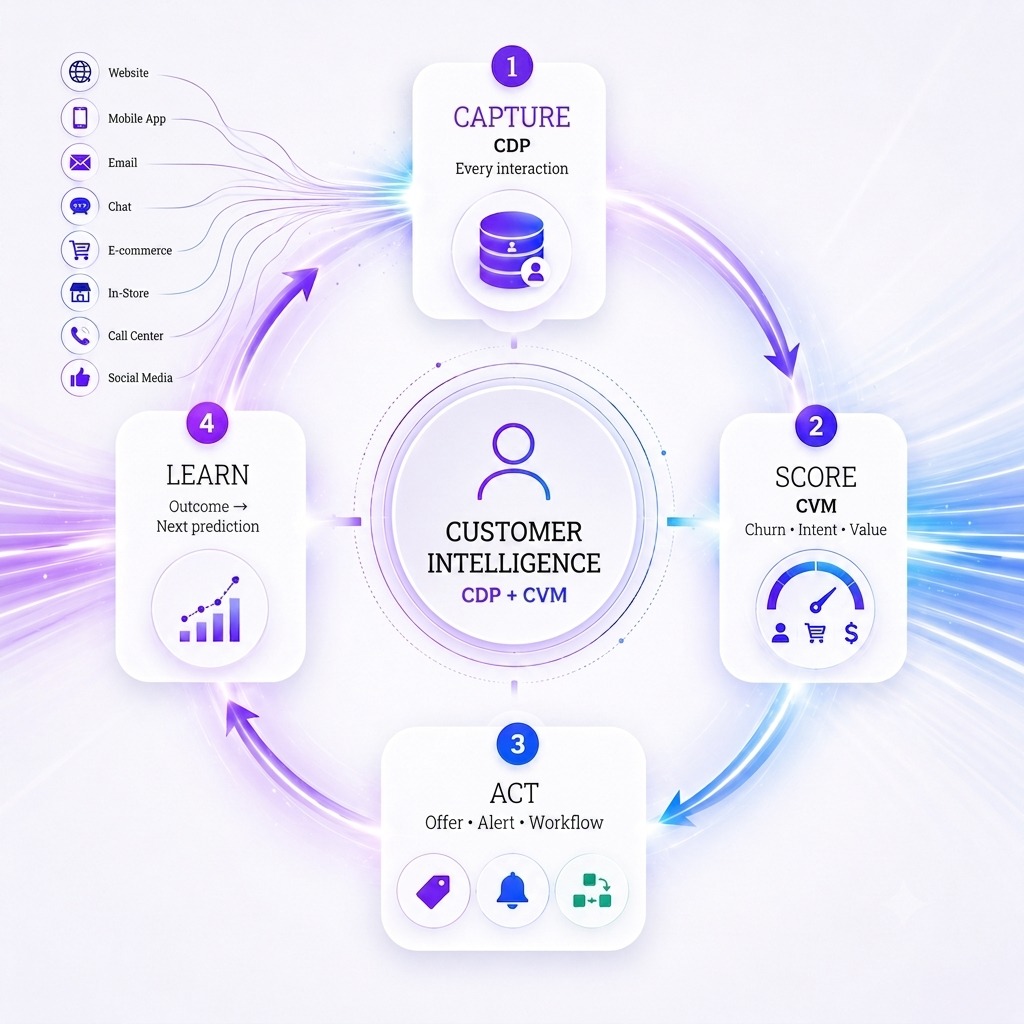
The relationship is sequential and continuous, not a one-time handoff:

  • The CDP captures a customer’s behavior across every channel and updates the profile in real time.
  • CVM logic scores that behavior against outcomes that matter — churn risk, purchase intent, lifetime value trajectory.
  • When a score crosses a threshold, CVM triggers a specific action — an offer, an alert to a relationship owner, a retention workflow — automatically.
  • The outcome of that action feeds back into the profile, refining the next prediction.

Remove the CDP, and CVM has nothing current to act on. Remove CVM, and the CDP is an expensive, accurate historical record that nobody uses fast enough to matter.

What is Customer Value Management CVM

Where This Shows Up Across Industries

• Financial services flagging a churn risk before renewal, or a product fit before the customer applies for it.

• Retail and ecommerce a cart abandonment or browsing pattern triggering a specific, timed offer instead of a generic discount blast.

• SaaS a usage decline flagged as a churn risk weeks before the renewal conversation, not during it.

• Telecom a usage pattern signaling upgrade readiness, surfaced to a rep before a competitor gets there first.

How to Tell If Your Deployment Has a CVM Layer

  • Can you name the last specific action a customer received because of something the platform detected, not because a person happened to notice it manually?
  • Is success measured by data completeness, or by a retention, cross-sell, or lifetime-value number that moved?
  • Does an insight trigger an action automatically, or does it wait for someone to open a dashboard and decide to act on it?
  • If the honest answer to any of these is “nobody’s really sure,” the deployment likely stopped at unification.

Where Worktual Fits

Worktual is built around Cognitive CDP and CVM together, not Cognitive CDP alone. Cognitive CDP is the unification layer, bringing customer data from every channel and connected system into one real-time profile. CVM is the strategy layer built directly on top of it, turning that profile into retention actions, cross-sell recommendations, and proactive outreach automatically, rather than leaving the insight for someone to find in a report. Data is hosted on Oracle Cloud, in line with standard data policies and security guardrails.

Conclusion

A unified customer profile is real progress, but it is not the finish line, and treating it as one is exactly why the CDP Institute finds most deployments fall short. The organizations getting revenue out of their customer data aren’t the ones with the most complete profile. They’re the ones where that profile automatically turns into an action — which is precisely what Customer Value Management, working with a Cognitive CDP, is built to do.

Frequently Asked Questions

1. What is Customer Value Management (CVM)?

The strategy layer that turns a unified customer profile into specific actions — retention offers, cross-sell recommendations, and proactive outreach timed to when they actually matter, rather than a fixed campaign schedule.

2. How is CVM different from a CDP?

A CDP unifies customer data into one profile and answers what a business knows about a customer. CVM sits on top of that profile and answers what the business should do about it.

3. Why do most CDP deployments fail to deliver value?

Only 64% of deployed CDPs deliver significant value, per the CDP Institute, largely because unification gets treated as the finish line rather than the starting point for an action layer like CVM.

4. Can a business have a CDP without CVM?

Yes, and many do — that combination produces an accurate, unified customer record that nobody consistently acts on fast enough to change an outcome.

5. What business outcomes does CVM typically improve?

Retention, cross-sell and upsell conversion, and customer lifetime value are the most common measurable outcomes, since CVM is built specifically to trigger action on those signals.

6. How does Worktual combine Cognitive CDP and CVM?

Cognitive CDP unifies customer data into one real-time profile; CVM, built directly on top of it, turns that profile into automatic retention, cross-sell, and engagement actions, rather than a report someone has to act on manually.

Related Posts

Multi Agent Ai Unified Intelligence

More Agents, Less Intelligence? Why Unified Intelligence is the Next Step for Enterprise

Insurance organizations operate in a complex, regulation-driven, margin-sensitive environment where growth depends on efficient onboarding, strong retention, and effective cross-sell across product lines. AI in insurance is central to this shift, as customers expect seamless digital onboarding journeys, real-time responses, and personalized communication across channels. Whether purchasing a policy, renewing coverage, or managing claims, expectations are shaped by digital-first experiences.

Ai native contact center vs traditional contact center

Traditional Contact Centers vs. AI-Native Contact Centers

A customer starts a conversation with your support chatbot about a billing issue. The chatbot creates a ticket but can’t resolve it.The next day, the customer calls your contact center. They explain the problem again. The agent transfers them to billing, where they explain everything for a third time.

Contact Center Revenue Engine Not Cost Center

Why the Contact Center Is Becoming a Revenue Engine, Not a Cost Center

Healthcare providers are managing an increasingly complex environment where operational efficiency, patient access, and revenue performance are tightly interconnected. Rising patient expectations, increasing administrative burdens, and workforce shortages continue to place pressure on both clinical and non-clinical teams. Patients now expect immediate responses, seamless scheduling, and consistent communication across channels, yet many healthcare systems still rely on fragmented processes and delayed engagement. These gaps result in missed appointments, underutilized capacity, and inconsistent patient care experiences that directly impact both outcomes and financial performance.