

More Agents, Less Intelligence? Why Unified Intelligence is the Next Step for Enterprise
Insights / More Agents, Less Intelligence? Why Unified Intelligence is the Next Step for Enterprise
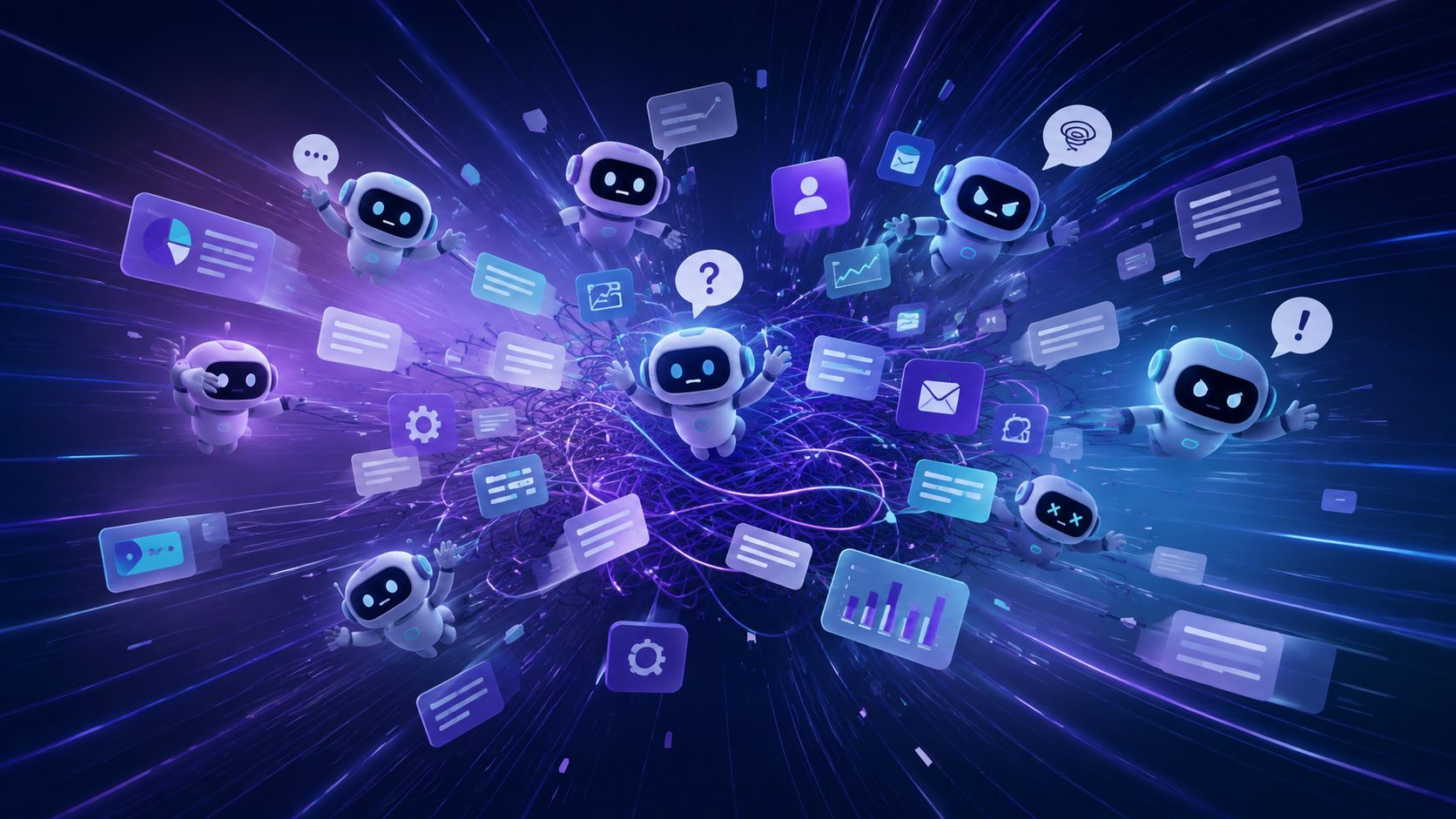
A customer emails to downgrade their plan. Within an hour, three AI systems respond to the same customer: a support bot processes the downgrade, a retention bot sends a loyalty discount, and a win-back system sends an email suggesting the customer has already left.
None of the systems has made an obvious mistake. Each has simply acted on the information and rules available to it. The problem is that they are not working from the same view of the customer.
This is becoming one of the biggest challenges in enterprise AI: not whether individual agents can perform their tasks, but whether multiple agents can work together without creating conflicting actions, losing context or making the same mistake in parallel. The research emerging in 2025 and 2026 suggests that adding more agents does not automatically solve the problem. In some situations, it can make it worse.
- The Industry Bet on More Agents
- What Happens When You Actually Test It
- The Taxonomy of What Goes Wrong
- Enterprises Are Living This at Scale
- What Unified Intelligence Actually Means
- Where This Leaves an Architecture Like Hub and Spoke
- Where This Actually Goes
- Conclusion
- FAQs
The Industry Bet on More Agents
The direction for enterprise AI in 2026 is clear: organisations are investing heavily in multi-agent systems.
Gartner lists multi-agent systems among its top strategic technology trends for 2026. Global AI spending is projected to reach $2.52 trillion, up 44% year on year, with agentic AI expected to drive much of that growth. Forrester expects AI agents to increasingly take on role-based work across enterprise systems and estimates that around 30% of enterprise application vendors will offer Model Context Protocol (MCP) servers in 2026 to help agents from different vendors communicate.
The thinking behind this approach is straightforward: instead of asking one AI system to do everything, give different agents specialised roles and let them work together.
The question is whether that approach actually works as well in practice as it does on paper.
What Happens When You Actually Test It
A 2025 study by researchers from Google Research, Google DeepMind and MIT tested 260 multi-agent configurations across six benchmarks and five different architectures. The tasks ranged from financial reasoning to sequential planning.
The results were more nuanced than simply “more agents = better performance”:
- More agents don’t always help. Once a single agent could solve a task correctly more than roughly 45% of the time, adding more agents often stopped improving performance and could actually make it worse.
- Coordination comes with a cost. When a task requires many tools, agents spend more of their capacity communicating and coordinating instead of doing the task itself. The researchers call this the coordination tax.
- Independent agents can amplify errors. When agents worked in parallel without checking each other’s work, errors were amplified by as much as 17.2 times compared with a single agent making the same type of mistake.
- Centralised validation performed better. Systems where one agent checked the work before it was finalised were much better at containing this error growth than systems where agents acted independently.
The takeaway isn’t that multi-agent systems don’t work. It’s that how the agents are coordinated matters at least as much as how many agents are involved.
The Taxonomy of What Goes Wrong
A separate UC Berkeley study examined the different ways multi-agent systems can fail. Researchers analysed more than 1,600 execution traces across seven popular multi-agent frameworks. Six expert reviewers classified the failures and reached a high level of agreement.
Their Multi-Agent System Failure Taxonomy (MAST) identified 14 different failure modes, grouped into three broad areas:
- Poor task definition — about 42% of failures: roles are unclear, tasks are handed over without enough information, agents duplicate work, or nobody knows when the task is complete.
- Agents don’t stay aligned — about 37%: one agent produces something another cannot use, multiple agents assume they own the same task, or important context is lost as work moves between them.
- Weak verification: the final output reaches the customer or a business system without anyone checking whether it is correct.
One particularly important problem is context loss. As agents pass information between one another, earlier decisions can disappear or become incomplete. Eventually, the system may no longer have a clear record of what was agreed earlier in the process.
There’s another concern too: agents using the same underlying model or tools can make the same mistake at the same time. What looks like several independent checks may therefore provide much less independent validation than it appears to.
Enterprises Are Living This at Scale
These challenges are already showing up as organisations deploy more AI agents across different teams and systems.
Gartner estimates that the average Fortune 500 company could be running more than 150,000 AI agents by 2028, compared with fewer than 15 in 2025. Yet only 13% of organisations say they currently have the governance needed to manage that growth.
Other research points to the same problem:
- 12 or more agents are already in use at the average organisation, according to Salesforce, with around half operating in silos.
- 70% of enterprise leaders in a 2026 Harvard Business Review study reported difficulty integrating AI agents with existing systems, often because the agents cannot access the data they need.
- Gartner estimates that integration and maintenance account for 40–60% of enterprise AI operating costs.
The pattern is familiar: as more agents are added, organisations can end up with more automation but less shared context. Different agents may be working with different versions of the same customer information, creating exactly the coordination and context problems highlighted in the research.
What Unified Intelligence Actually Means
The research does not suggest that enterprises should simply use fewer agents. It suggests that agents need a shared source of truth and a clear way to coordinate their work.
A centralised architecture can provide that structure. Instead of each agent working from its own partial view, specialised agents can work from the same current customer information. Their recommendations can then be checked against shared context and business rules before anything is acted on.
In practice, that means:
- One shared customer view rather than separate versions of the same data.
- Specialised agents that each focus on a specific task or decision.
- Shared context so important information is not lost between agents.
- A validation point that checks recommendations before they reach the customer or a business system.
- Clear governance over what agents can recommend and what they are allowed to execute.
The research therefore points towards better coordination and architecture, rather than simply increasing the number of agents.
Where This Leaves an Architecture Like Hub and Spoke
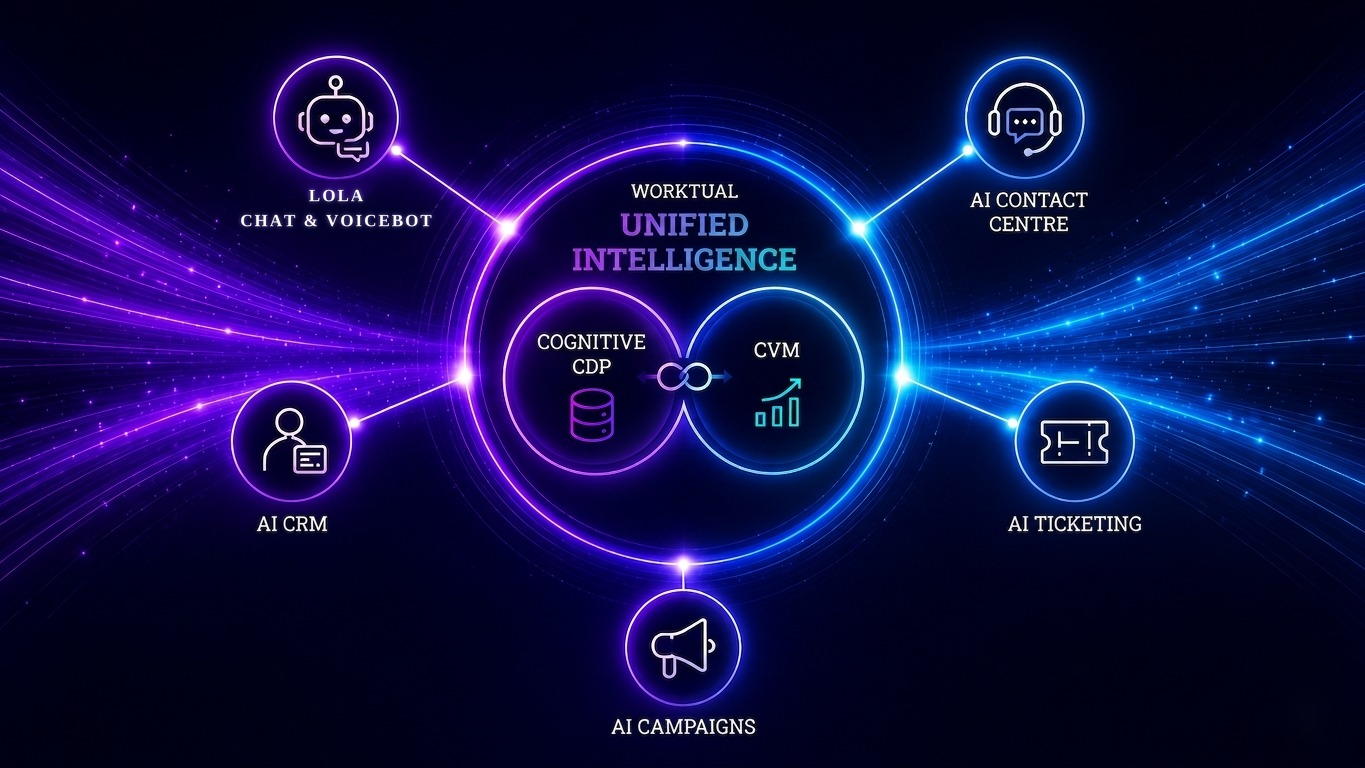
A hub-and-spoke model is one way to put these principles into practice. The idea is simple: specialised agents can do different jobs, but they all work through a shared intelligence layer rather than maintaining separate versions of customer data.
In Worktual’s architecture:
- The Cognitive CDP acts as the hub — specialised agents continuously bring together customer data, resolve identities and build a single customer profile, including signals such as churn risk, lifetime value and purchase propensity.
- CVM strategy agents work from that shared profile — they can recommend the next best action, such as a retention treatment, journey or offer.
- A CDP Super Agent provides the control point — recommendations are checked against consent, business rules, budgets and active campaigns before anything is released.
- Spoke systems execute the approved action — such as the AI Contact Centre, CRM, ticketing or campaign systems.
The architecture also allows agents to work differently depending on the task. Independent decisions can be made in parallel, while decisions that depend on one another can be handled sequentially through the same validation point.
This doesn’t remove every risk. A central validation layer can reduce error amplification, but it cannot eliminate unclear instructions or context loss within an individual agent. The architecture also needs ongoing governance as new agents and systems are added.
Where This Actually Goes
The research points to a fairly clear conclusion: multi-agent systems can be valuable when a task genuinely benefits from specialised agents, but adding agents without a shared view and clear coordination can create new problems.
For enterprises, the challenge is therefore not simply deciding how many agents to deploy. It is deciding how those agents share information, coordinate decisions and validate actions.
Many organisations are already deploying agents across different teams and platforms, often with limited shared context. The research suggests that this fragmented approach is unlikely to scale reliably. A shared intelligence layer, clear governance and a defined validation point can provide the structure needed as the number of agents grows.
The multi-agent landscape is still developing, and the coordination problem is far from solved. That makes architecture an important part of enterprise AI strategy—not an issue to address after the agents have already been deployed.
Conclusion
Multi-agent AI has clear potential for enterprise applications, particularly when work can be divided across specialised agents. But the research shows that adding more agents does not automatically produce better results.
As agent deployments grow, the bigger challenge becomes coordination: making sure agents have the right context, understand their roles, share information and have their output checked before it reaches a customer or business system.
For enterprises, the question is therefore not simply “How many AI agents should we deploy?” It is “How should those agents work together?” A shared intelligence layer, clear governance and controlled validation can provide the structure needed to make multi-agent systems more reliable as they scale.
The technology and research are still evolving. What is becoming clear is that architecture matters as much as agent capability.
Learn more about Worktual’s Unified Intelligence
Frequently Asked Questions
1. What is a multi-agent AI system?
A multi-agent AI system uses multiple specialised AI agents to work on different parts of a task or business process. Each agent may have a specific role, with the agents coordinating to complete the wider task.
2. Does adding more AI agents improve performance?
Not necessarily. Research shows that once a single agent can handle a task reasonably well, adding more agents can stop improving performance and may introduce coordination costs or additional errors.
3. What is the coordination tax in multi-agent AI?
The coordination tax is the capacity agents spend communicating and coordinating with each other instead of completing the task itself. The more tools and agents involved, the greater this overhead can become.
4. What are the most common problems with multi-agent systems?
Research identifies problems including unclear roles, incomplete handoffs, duplicated work, poor coordination, lost context and insufficient verification of the final output.
5. Why is shared context important for AI agents?
Without shared context, different agents may work from different or incomplete versions of the same information. This can lead to conflicting recommendations, repeated work or decisions that ignore what another agent has already done.
6. What is a hub-and-spoke architecture for AI agents?
It is an architecture where specialised agents operate as spokes around a central intelligence layer or hub. The hub provides shared context and can validate recommendations before approved actions are passed to the systems that execute them.
7. How does Worktual use a hub-and-spoke model?
Worktual uses the Cognitive CDP as the central intelligence layer, with specialised agents working from a unified customer profile. CVM strategy agents recommend actions, while the CDP Super Agent validates those recommendations against consent, business rules, budgets and active campaigns before they reach systems such as the AI Contact Centre, CRM, ticketing or campaign platforms.
8. Does a centralised architecture eliminate the risks of multi-agent AI?
No. Centralised validation can reduce error amplification, but it does not eliminate problems such as unclear instructions or context loss within individual agents. The architecture still requires ongoing governance as new agents and systems are added.
Related Posts

One Customer Profile, Four Solutions, One Decision
Insurance organizations operate in a complex, regulation-driven, margin-sensitive environment where growth depends on efficient onboarding, strong retention, and effective cross-sell across product lines. AI in insurance is central to this shift, as customers expect seamless digital onboarding journeys, real-time responses, and personalized communication across channels. Whether purchasing a policy, renewing coverage, or managing claims, expectations are shaped by digital-first experiences.

Fragmented AI Investment Is a Valuation Problem, Not Just a Cost Problem
Insurance organizations operate in a complex, regulation-driven, margin-sensitive environment where growth depends on efficient onboarding, strong retention, and effective cross-sell across product lines. AI in insurance is central to this shift, as customers expect seamless digital onboarding journeys, real-time responses, and personalized communication across channels. Whether purchasing a policy, renewing coverage, or managing claims, expectations are shaped by digital-first experiences.
AI-Native vs AI-Powered SaaS: What Is the Difference?
Insurance organizations operate in a complex, regulation-driven, margin-sensitive environment where growth depends on efficient onboarding, strong retention, and effective cross-sell across product lines. AI in insurance is central to this shift, as customers expect seamless digital onboarding journeys, real-time responses, and personalized communication across channels. Whether purchasing a policy, renewing coverage, or managing claims, expectations are shaped by digital-first experiences.


