

AI-Native vs AI-Powered SaaS: What Is the Difference?
Insights / AI-Native vs AI-Powered SaaS: What Is the Difference?
Table of Contents
Why Almost Every SaaS Product Now Says It Is AI-Powered
AI has become a standard feature across enterprise software. CRMs can summarize customer interactions, project management platforms can recommend priorities, and business applications can generate content or surface patterns in data.
These capabilities can be useful. But the growing number of AI features has also made it harder for buyers to understand what “AI-powered” actually means.
An AI assistant added to an existing application does not necessarily change how the underlying product works. The AI may perform a specific task while the rest of the application continues to operate much as it did before.
That makes the presence of an AI feature a limited buying signal. For enterprise buyers, the more useful question is how deeply AI is integrated into the product: what data it can access, how it uses context, whether it can support decisions, and how far it can act across business workflows.
What Is AI-Powered SaaS?
AI-powered SaaS generally refers to an existing software application that has been enhanced with AI capabilities.
For example, an established CRM may add an AI assistant that summarizes customer records, drafts follow-up emails, or answers questions about information already stored in the system. The AI adds useful capabilities without fundamentally changing the application’s underlying architecture.
This approach can work well for specific use cases. Businesses may gain faster access to information, reduce repetitive work, or help employees complete individual tasks more efficiently.
The key point is that AI is typically being added to an existing product rather than forming the foundation around which the product was designed.
What Is AI-Native SaaS?
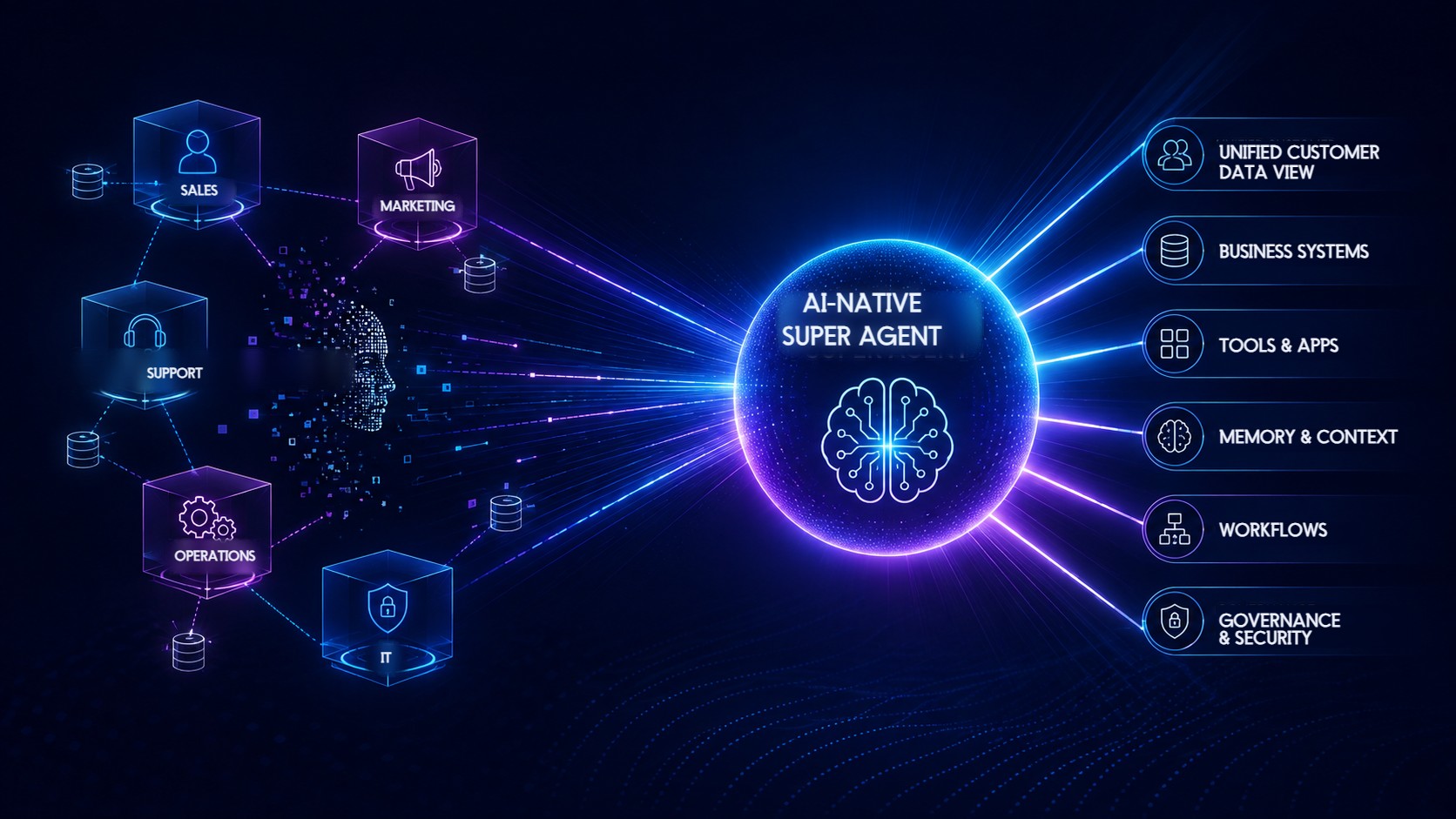
AI-native SaaS is designed with AI as a core part of the product architecture, rather than treating AI as a separate feature layer.
Instead of limiting AI to individual features, an AI-native platform can use AI across the workflow to understand context, identify patterns, make predictions, support decisions and, where appropriate, take action.
That requires more than a capable model. The platform also needs access to relevant data, business context, permissions and connected systems.
For example, an AI-native customer platform could use customer history, recent interactions and current behavior to identify a change in intent, determine an appropriate next step and support the workflow required to act on it.
The difference is therefore less about whether a product contains AI and more about the role AI plays within the product.
AI-Native vs AI-Powered: Key Differences
| Aspect | AI-Powered SaaS | AI-Native SaaS |
|---|---|---|
| Architecture | AI capabilities added to an existing application | AI designed into the core product architecture |
| Role of AI | Supports specific tasks | Can support understanding, prediction, decisioning and action |
| Data and context | Often works within the data available to a feature or application | Designed to work with broader, connected context |
| Decision-making | Primarily provides recommendations or assistance | Can support decisioning within defined rules and permissions |
| Automation | Usually focused on individual tasks | Can support complete workflows |
| Personalization | Often based on rules, segments or available application data | Can use current customer and business signals to adapt actions |
| Cross-workflow action | Typically limited to the application where the feature exists | Can work across connected systems and workflows |
The distinction is architectural rather than a simple ranking of one approach over the other. AI-powered SaaS can be the right choice for a focused business need, while AI-native architecture may be more relevant when an organization wants intelligence embedded across broader workflows.
Why the Difference Matters for US Enterprises
Enterprise AI adoption is already widespread. Stanford’s 2026 AI Index reports that organizational AI adoption reached 88%, while AI agent deployment remains in the single digits across nearly all business functions.
Deloitte’s 2026 State of AI in the Enterprise research also points to a shift from experimentation toward scale. Its research found that worker access to AI increased by 50% in 2025, while only 34% of surveyed organizations said they were using AI to deeply transform the business.
For US enterprise buyers, this creates a practical challenge. Buying software with an AI feature is relatively easy. Determining whether that AI can deliver value across real business processes is harder.
Several questions become important:
- Can AI move from pilots into production workflows?
- Can it work with existing enterprise systems?
- Does it have access to the customer and business context it needs?
- Can it support decisions rather than only generate responses?
- Can it take appropriate action within defined permissions?
- How are security, governance and auditability handled?
- Can the underlying AI models evolve without requiring a complete platform change?
- Can the business measure outcomes rather than simply track AI usage?
The goal is not to choose AI-native software simply because the label sounds more advanced. It is to understand whether the architecture matches the business problem the enterprise is trying to solve.
The Importance of Data, Context and Integration
AI needs context to make useful decisions.
For an enterprise application, that context can include customer history, behavior, transactions, interactions, business rules and information from multiple systems. It also needs to be sufficiently current to reflect what is happening now rather than relying entirely on an outdated snapshot.
Consider a customer who contacts support after abandoning a high-value purchase. A support system that sees only the latest message may treat the interaction as an isolated service request. A system with broader customer context can recognize the purchase behavior, previous interactions and account value before determining the appropriate response.
Fragmented data limits this kind of intelligence. When customer information is distributed across disconnected systems, AI may understand one part of the relationship while missing another.
This is why data architecture, integration and context are important when evaluating AI SaaS. A more capable model cannot fully compensate for missing business information.
From AI Assistance to AI-Driven Action
The difference becomes clearer when looking at what happens after AI identifies something.
AI summarizes a customer interaction:
An AI-powered tool can summarize the conversation. An AI-native system can use that interaction together with customer history and current signals to help determine the next step.
AI recommends an offer:
An AI-powered tool can suggest an offer to an employee. A more deeply integrated AI workflow can use customer context to identify the appropriate customer, select a relevant action and trigger it within defined rules.
AI answers a support question:
An AI assistant can provide an answer from available knowledge. A more integrated AI workflow can access the relevant systems and complete an appropriate resolution when the required permissions and integrations are available.
This does not mean AI should operate without oversight. Enterprise AI still requires defined permissions, governance and escalation paths. The difference is how much of the workflow the system can support beyond generating an answer.
What US Enterprises Should Look for When Evaluating AI SaaS
When evaluating an AI-enabled SaaS platform, buyers can look beyond the presence of an AI assistant or chatbot.
| Evaluation Area | What US Enterprises Should Check | Why It Matters |
|---|---|---|
| AI Architecture | Is AI central to the platform's architecture or added to individual features? | Helps determine how deeply AI is integrated into the software. |
| Data and Context | What customer, operational and business information can the AI access? | AI needs relevant context to produce useful responses and decisions. |
| Data Freshness | Is the information continuously updated or based on older snapshots? | Current information helps AI respond to changing customer and business conditions. |
| Cross-System Integration | Can the AI work across connected applications and workflows? | Enterprise processes often involve multiple systems rather than a single application. |
| Decision-Making | Can the AI support decisioning as well as generate responses or recommendations? | Shows whether AI can contribute beyond basic assistance. |
| Ability to Take Action | What actions can the AI perform, and under what permissions or rules? | Helps assess how far AI can support or automate a workflow. |
| Security and Governance | How are permissions, controls, monitoring and auditability managed? | Important for maintaining oversight as AI takes on more responsibilities. |
| AI Model Flexibility | Can the platform adapt or upgrade as AI models and capabilities evolve? | Helps businesses avoid being locked into a fixed AI approach as the technology changes. |
| Business Outcomes | How will the business measure efficiency, revenue, retention, customer experience or other outcomes? | Ensures AI investments are evaluated based on measurable business value. |
Where Worktual Fits
Worktual is positioned as an AI-native enterprise platform built around shared customer intelligence.
Its Cognitive CDP provides a unified, continuously updated view of customer data from connected systems. CVM works alongside that intelligence to use customer context for prediction, scoring and decisioning. The AI-native CRM brings that intelligence into customer and business workflows, while Lola, Worktual’s conversational AI, can use relevant customer context during interactions and support appropriate actions.
Together, these capabilities provide a shared intelligence foundation for understanding customers and supporting decisions across workflows. The value comes from connecting customer context with prediction, decisioning and interaction rather than treating AI as an isolated feature.
Conclusion
AI-powered and AI-native SaaS can both provide business value. The important difference is how AI is integrated into the product.
AI-powered SaaS typically adds AI capabilities to an existing application. AI-native SaaS is designed with AI as part of the platform’s architecture, allowing intelligence to play a broader role in understanding context, predicting outcomes, supporting decisions and taking action.
For enterprises evaluating SaaS, the presence of an AI feature is only the starting point. The more useful questions concern the data AI can access, the context it can understand, the workflows it can support, the decisions it can influence and the controls that govern its actions.
As AI becomes more deeply embedded in enterprise software, those architectural differences will become increasingly important to how businesses evaluate technology investments.
Frequently Asked Questions
1. What is AI-native SaaS?
AI-native SaaS is software designed with AI as part of its core architecture. AI can be integrated into areas such as understanding context, prediction, decisioning, automation and workflow execution.
2. What is AI-powered SaaS?
AI-powered SaaS is an existing software application enhanced with AI capabilities. Examples include AI assistants, copilots, summarization tools, recommendations and task automation.
3. What is the difference between AI-native and AI-powered SaaS?
AI-powered SaaS generally adds AI capabilities to an existing application. AI-native SaaS is designed around AI as part of the core architecture, allowing it to play a broader role across data, decisioning and workflows.
4. Is AI-native SaaS better than AI-powered SaaS?
Not necessarily. AI-powered SaaS can be effective for specific, well-defined use cases. AI-native SaaS may be more suitable when a business wants AI to operate across broader workflows and use connected context for decisioning and action.
5. Why does context matter for enterprise AI?
AI needs relevant business and customer information to produce useful decisions. Context can include customer history, behavior, transactions, interactions, business rules and current information from connected systems.
6. What should US enterprises look for in AI-native software?
Enterprises should evaluate the platform’s architecture, data access, context, integration capabilities, decisioning, ability to take action, security, governance, model flexibility and measurable business outcomes.
7. Is Worktual an AI-native platform?
Yes. Worktual is positioned as an AI-native enterprise platform that connects Cognitive CDP, CVM, AI-native CRM and conversational AI around shared customer intelligence.
Related Posts

Fragmented AI Investment Is a Valuation Problem, Not Just a Cost Problem
Insurance organizations operate in a complex, regulation-driven, margin-sensitive environment where growth depends on efficient onboarding, strong retention, and effective cross-sell across product lines. AI in insurance is central to this shift, as customers expect seamless digital onboarding journeys, real-time responses, and personalized communication across channels. Whether purchasing a policy, renewing coverage, or managing claims, expectations are shaped by digital-first experiences.

The Enterprise Software Shift in 2026: What the Data Actually Shows
Insurance organizations operate in a complex, regulation-driven, margin-sensitive environment where growth depends on efficient onboarding, strong retention, and effective cross-sell across product lines. AI in insurance is central to this shift, as customers expect seamless digital onboarding journeys, real-time responses, and personalized communication across channels. Whether purchasing a policy, renewing coverage, or managing claims, expectations are shaped by digital-first experiences.

Hub-and-Spoke vs. Siloed AI Architecture: Key Differences
Insurance organizations operate in a complex, regulation-driven, margin-sensitive environment where growth depends on efficient onboarding, strong retention, and effective cross-sell across product lines. AI in insurance is central to this shift, as customers expect seamless digital onboarding journeys, real-time responses, and personalized communication across channels. Whether purchasing a policy, renewing coverage, or managing claims, expectations are shaped by digital-first experiences.


