

How to choose the best conversational AI tool 2026: a strategic approach to platform selection
Insights / How to choose the best conversational AI tool 2026: a strategic approach to platform selection
Table of Contents
The best conversational AI platforms in 2026 are Worktual, Intercom, Zendesk AI, Drift, Dialogflow, Ada, LivePerson, Tidio, Freshdesk AI, and Botpress — each suited to different business sizes, verticals, and technical requirements.
Choosing the right platform requires evaluating: NLP accuracy, CRM integration depth, omnichannel support, human escalation paths, compliance certifications, scalability, and whether the system is bespoke or templated.
This guide covers all 10 platforms with a full comparison table, a 15-point evaluation checklist, and a buyer’s decision framework — helping you identify the best conversational AI platform for your specific needs.
The conversational AI market has matured rapidly. In 2026, businesses are no longer asking whether to deploy conversational AI — they are asking which platform to choose. And with over 200 platforms now competing for enterprise contracts, the selection decision has become as complex as the technology itself.
This guide is built differently. Rather than listing platforms alphabetically, it starts with the questions enterprises are actually asking in 2026 — from ‘which conversational AI tool has the best CRM integration’ to ‘how do I choose a platform that scales globally’ — and builds a framework that answers them.
The result is the most comprehensive conversational AI platform comparison available for 2026 — with real evaluation criteria, a downloadable checklist, and clear recommendations by business size and use case.
- What Is Conversational AI?
- Conversational AI Market Overview 2026
- Conversational AI Use Cases in Business
- Key Features to Look for In a Conversational AI Platform
- The Conversational AI Platform Evaluation Checklist 2026
- Comparison of Enterprise-Grade AI Chatbot Tools
- Best Conversational AI Tools in 2026: 10 Platforms Compared
- How to Choose the Best Conversational AI Platform for Your Business
- Conversational AI for Enterprise: Scalability, Security & Compliance
- Conversational AI and CRM Integration: What to Evaluate
- Conversational AI by Industry: Which Platform Fits Your Sector
- FAQs
What Is Conversational AI?
Conversational AI is technology that enables software systems to hold natural, two-way dialogues with humans — understanding intent, maintaining context, and taking action without requiring human agents for every interaction. In 2026, the best conversational AI tools combine five capabilities:
- Natural Language Processing (NLP): Understanding what users mean, not just what they say — including intent, sentiment, and context within a conversation.
- Machine Learning: Improving accuracy and relevance with every interaction, building a progressively more accurate model of the business’s customers.
- Workflow Automation: Completing tasks — processing refunds, booking appointments, updating CRM records — not merely responding.
- Omnichannel Delivery: Maintaining consistent, context-aware conversations across web chat, email, SMS, WhatsApp, voice, and social.
- Analytics and Intelligence: Converting every conversation into structured business data — query categories, sentiment trends, resolution rates, and escalation patterns.
The distinction between conversational AI tools and traditional rule-based chatbots is now commercially significant. A 2025 study found 67% of businesses reported their chatbot technology did not meet expectations — almost universally because they deployed rule-based systems with conversational AI marketing. The platforms in this guide are genuine conversational AI, validated against enterprise deployment outcomes.
Conversational AI Market Overview 2026
The conversational AI market stood at $13.64 billion in 2025 and is on track to reach $42.51 billion by 2030, growing at 25% annually (MarketsandMarkets). Gartner forecasts that conversational AI will cut contact centre labour costs by $80 billion in 2026 alone.
Despite this scale, adoption success remains uneven. The Qualtrics 2026 Customer Experience Trends Report found that nearly one in five consumers who used AI for customer service saw no benefit — a failure rate almost four times higher than for AI in general. The differentiator is platform selection: the right conversational AI tool transforms customer experience; the wrong one compounds the problem it was meant to solve.
The Strategic Importance of Platform Selection
When evaluating scalable AI solutions, the temptation is to focus on immediate needs: reducing customer queries, improving response times, or cutting costs. Whilst these are valid considerations, they represent tactical thinking rather than strategic planning.
The more important question is how your chosen conversational AI platform for business will enable competitive advantage. This requires understanding three key principles:
Network effects in customer data: The more customer interactions your platform processes, the better it becomes at understanding your specific customer base and industry context. This creates a compounding advantage over time.
Integration depth determines value: Superficial integrations provide superficial value. The AI communication platform for companies that becomes truly valuable is the one that connects deeply with your existing systems and workflows.
Scalability is about complexity, not just volume: True scalability means handling increasingly sophisticated customer needs without proportional increases in human intervention.
Conversational AI Use Cases in Business
Understanding real-world applications is essential when evaluating the best conversational AI tools. While capabilities may vary, most AI chatbot for business solutions are designed to solve common operational challenges across industries.
Customer Support Automation
Conversational AI for customer service enables businesses to handle high volumes of queries instantly. From answering FAQs to resolving complex issues, AI reduces response times while maintaining consistency.
Sales and Lead Qualification
AI chatbots can engage website visitors, qualify leads based on predefined criteria, and route high-value prospects to sales teams. This improves conversion rates without increasing manual effort.
E-commerce Assistance
For transactional businesses, conversational AI platforms guide customers through product discovery, recommend items, and assist with order tracking and returns, creating a seamless shopping experience.
Appointment Scheduling and Service Requests
Service-based industries use AI to automate bookings, manage schedules, and handle customer requests, reducing administrative overhead.
Customer Retention and Engagement
Advanced platforms proactively engage customers through personalised messages, reminders, and offers, helping businesses improve retention and lifetime value.
These use cases highlight how the best conversational AI platform evolves from a support tool into a strategic asset that drives both efficiency and growth.
Key Features to Look for In a Conversational AI Platform
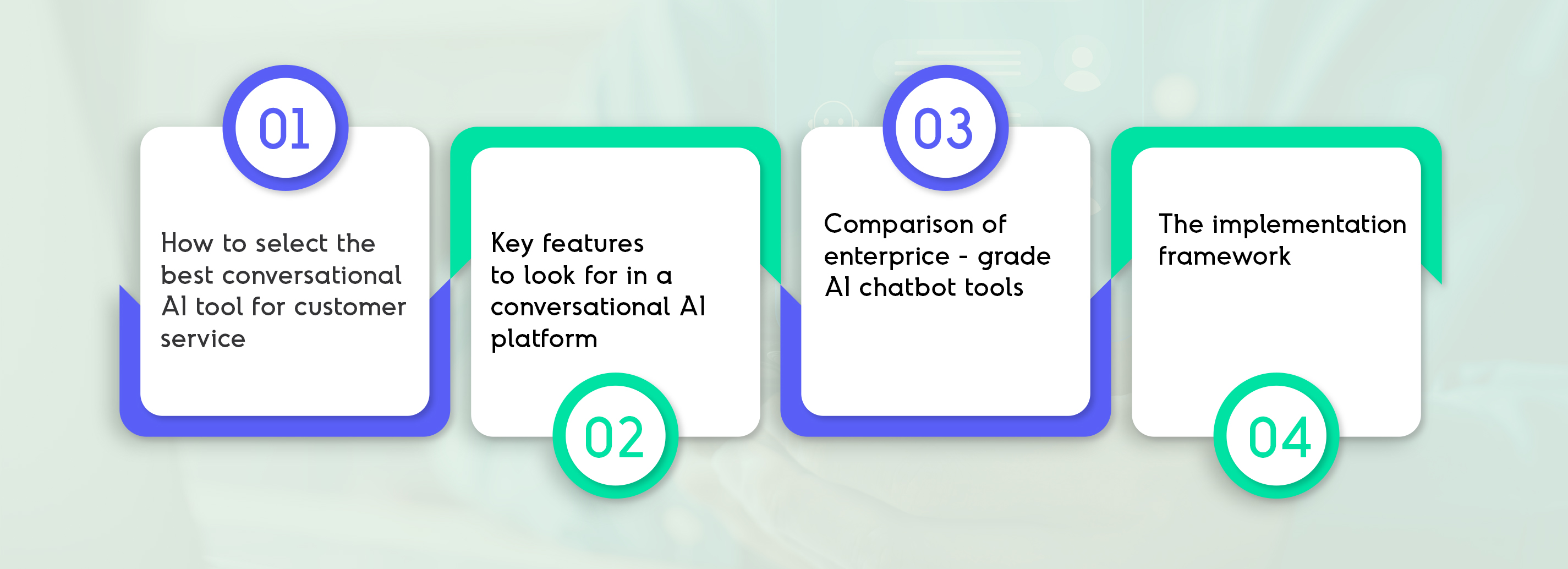
These are the 10 features that separate enterprise-grade conversational AI platforms from tools that look capable in a demo but underperform in production. Evaluate each platform against all 10 before making a decision.
1. Natural Language Understanding (NLU) Accuracy
The platform must understand free-form customer queries — not just keyword-matched phrases. Test NLU with your actual customer query types: ambiguous phrasings, emotional language, multi-part requests, and product-specific terminology. Red flag: any platform that requires you to define keywords or intents manually for most use cases.
2. Context Retention and Conversational Memory
Enterprise-grade platforms maintain context across a full conversation — remembering what was said three exchanges ago and connecting it to the current query. They also maintain context across sessions: if a customer called yesterday about an order, the AI should know that today. The best conversational AI tools in 2026 offer long-term memory as a core capability, not an add-on.
3. CRM and System Integration Depth
Superficial integrations provide superficial value. The platform should connect natively with your CRM (Salesforce, HubSpot, Microsoft Dynamics), ERP, ticketing system, payment gateway, and knowledge base — enabling real-time data retrieval and action execution mid-conversation. Evaluate the integration architecture: native API vs webhook vs middleware — and ask whether the integration is bidirectional.
4. Human Escalation Paths and Agent Handoff
‘What happens when the AI can’t handle it?’ is the first question from every enterprise buyer — and the answer defines the quality of the platform. Best-in-class platforms escalate intelligently: they detect the need before the customer has to ask, transfer with full conversation context pre-loaded, and enable agent-assist mode where AI suggests responses to human agents in real time. Lola escalates with complete interaction history — the agent never asks the customer to repeat themselves.
5. Omnichannel Consistency
Customers don’t stay on one channel. A query that starts on web chat moves to WhatsApp, then to voice. The platform must maintain context across all channels without requiring the customer to re-identify themselves. Evaluate whether context is truly shared across channels or merely siloed per channel with a unified interface on top.
6. Multilingual and Regional Capability
If your business operates across multiple markets, the platform must support natural conversation in each market’s primary language — with accent awareness, regional idiom comprehension, and localised response quality. Template-based platforms support multiple languages; bespoke platforms support your customers’ specific language patterns in each market.
7. Compliance Certifications — GDPR, HIPAA, SOC2
For UK and EU deployments: GDPR compliance requires lawful basis for conversation processing, data retention controls, PII handling protocols, and right-to-erasure capability. For healthcare: HIPAA compliance requires specific data handling and storage protocols. For financial services: FCA (UK) and PCI-DSS compliance may apply to payment-adjacent conversations. Ask for specific compliance certification documentation — not just marketing claims.
8. Analytics and Business Intelligence
Every conversation should generate structured business intelligence: query categories, resolution rates, sentiment trends, escalation triggers, peak load times, and intent-accuracy scores. The best conversational AI platforms in 2026 provide analytics that enable business decisions — not just operational metrics that count conversations.
9. Bespoke Architecture vs Shared Template
This is the most significant and least-discussed differentiator in the 2026 market. Template-based platforms deploy the same system architecture across thousands of clients — any competitive advantage evaporates the moment your competitor buys the same licence. Bespoke platforms are built around your business: your data, your workflows, your customers, your compliance requirements. Worktual’s architecture is bespoke by design — no two deployments share underlying intelligence.
Pricing Model and Total Cost of Ownership
Conversational AI pricing models vary significantly: per-seat, per-conversation, per-resolution, per-message, or bespoke project pricing. Evaluate total cost of ownership over 3 years — not just year-one licence fees. Include: integration costs, training and onboarding, ongoing customisation, and support tier costs. Platforms with low headline pricing often carry high integration and maintenance costs that erode the ROI case.
The Conversational AI Platform Evaluation Checklist 2026
Use this 15-point checklist when evaluating any conversational AI platform. Score each criterion 1-5 and compare total scores across shortlisted platforms.
| # | EVALUATION CRITERION | WHAT TO VERIFY |
|---|---|---|
| 1 | NLP Accuracy | Test with your real customer query types |
| 2 | Contextual Memory (short + long term) | Does AI remember context across sessions? |
| 3 | CRM Integration (bidirectional) | Salesforce/HubSpot/Dynamics native support? |
| 4 | Human Escalation with Context Transfer | Does agent receive full conversation history? |
| 5 | Omnichannel (web, voice, WhatsApp, SMS, email) | Single context across all channels? |
| 6 | Multilingual Support | How many languages, at what quality level? |
| 7 | Compliance Certifications | GDPR, HIPAA, SOC2 — request documentation |
| 8 | Analytics Depth | Business intelligence vs operational metrics only? |
| 9 | Bespoke vs Template Architecture | Is it built for you or deployed for thousands? |
| 10 | Time to Deploy | Weeks or months? What does onboarding require? |
| 11 | Pricing Model | Per-seat / per-conversation / per-resolution? |
| 12 | Vendor Support SLA | Response time guarantee? Dedicated support? |
| 13 | AI Learning / Continuous Improvement | Does the model improve post-deployment? |
| 14 | Voice + Chat Integration | Unified intelligence across voice and text? |
| 15 | References / Proven Deployments | Can vendor provide relevant case studies? |
Comparison of Enterprise-Grade AI Chatbot Tools
The market has consolidated around several distinct approaches, each with different strategic implications:
Integrated customer experience platforms like Intercom embed conversational AI within broader customer relationship management systems. This approach provides seamless handoffs between AI and human agents but may limit integration with external systems.
Specialised conversational AI platforms such as Worktual focus exclusively on AI-native conversations. These platforms often provide superior AI capabilities and flexibility but require more integration work.
Enterprise software extensions like Zendesk AI leverage existing customer service investments. This approach minimises implementation complexity but may not deliver the full potential of modern conversational AI.
The choice between these approaches should align with your broader technology strategy and organisational capabilities.
Industry-Specific Considerations
Healthcare organisations must prioritise compliance and privacy above all other considerations. The enterprise conversational AI software that handles patient data must meet strict regulatory requirements whilst providing the conversational sophistication that patients expect.
Financial services require platforms that can securely handle sensitive information whilst providing the immediate responses that customers demand for account customer queries and transaction support.
E-commerce businesses need platforms that understand product catalogues and can provide personalised recommendations whilst seamlessly integrating with inventory and order management systems.
Professional services firms require platforms that can qualify leads effectively whilst projecting the expertise and professionalism that clients expect.
Best Conversational AI Tools in 2026: 10 Platforms Compared
The following platforms represent the leading enterprise-grade conversational AI tools available in 2026. Each has been evaluated against the 10 key features above, with specific strengths, limitations, and best-fit use cases.
| PLATFORM | KEY STRENGTH | LIMITATION | BEST FOR |
|---|---|---|---|
| Worktual (Lola) | Bespoke agentic AI — built around your business | Investment reflects bespoke build | Enterprises needing permanent competitive advantage, complex workflows, omnichannel CX |
| Intercom | Strong CRM + live chat hybrid, Fin AI is capable | Expensive at scale; AI needs config | SaaS businesses blending sales and support conversations |
| Zendesk AI | Deep native integration with Zendesk ticketing | Limited flexibility outside Zendesk | Existing Zendesk users wanting AI uplift without platform change |
| Drift | Revenue-focused conversational marketing | Primarily B2B sales; weak for support | B2B companies prioritising lead qualification and pipeline acceleration |
| Dialogflow (Google) | Powerful NLP, highly customisable | Requires developer resource; not plug-and-play | Tech teams building custom voice/chat integrations on Google infrastructure |
| Ada | Fast deployment, easy configuration | Less depth for complex enterprise workflows | Mid-market companies needing rapid deployment with manageable IT overhead |
| LivePerson | Enterprise-grade voice + messaging, long track record | Complex pricing; implementation-heavy | Large enterprises with high voice call volumes needing omnichannel unification |
| Tidio | Affordable, easy setup, ecommerce integrations | Limited enterprise scalability | SMEs and ecommerce businesses needing a cost-effective starting point |
| Freshdesk AI (Freshchat) | Strong helpdesk integration, competitive pricing | AI capabilities less advanced than leaders | Support-focused teams already in the Freshworks ecosystem |
| AI ChatIQ | AI-powered website conversations and lead Capture | Best suited for businesses focused on website engagement and lead conversion | Businesses looking to engage visitors, qualify leads, capture prospects, and automate customer conversations |
| Botpress | Open-source flexibility, strong developer community | Requires technical expertise to deploy effectively | Developer-led teams wanting full control over conversation logic and hosting |
How to Choose the Best Conversational AI Platform for Your Business
Platform selection should begin with your business model, not a feature comparison. Different business models create fundamentally different conversational AI requirements.
Step 1: Define Your Primary Use Case
Identify the core problem you are solving: high inbound call volume, lead qualification, ecommerce support, internal knowledge management, or proactive outbound engagement. Your primary use case determines which features are non-negotiable and which are secondary.
Step 2: Audit Your Current Query Mix
Before evaluating any platform, analyse your top 20 customer query types by volume. Categorise each as: FAQ (resolvable with knowledge base), transactional (requires system integration to resolve), or complex (requires contextual reasoning). This audit determines the AI capability level your deployment requires.
Step 3: Assess Your Integration Requirements
List every system the conversational AI must access: CRM, ERP, inventory management, payment gateway, ticketing, scheduling, and knowledge base. Rate each integration as: critical (conversation cannot be resolved without it), important (significantly improves resolution), or nice-to-have. Any platform that cannot provide critical integrations is disqualified before pricing is discussed.
Step 4: Evaluate Compliance Requirements
For regulated industries, compliance requirements narrow the field significantly. GDPR (UK/EU), HIPAA (US healthcare), PCI-DSS (payment processing), and FCA regulations (UK financial services) each impose specific requirements on how customer data is processed, stored, and deleted. Request compliance documentation — not marketing assurances.
Step 5: Test with Real Customer Data
Insist on a pilot with your actual customer query types — not a curated demo. Present the platform with your top 20 query categories and evaluate: resolution accuracy, escalation behaviour, integration performance, and response quality. A platform that performs brilliantly in a demo but struggles with your specific customer language is not the right fit.
Step 6: Evaluate the Bespoke vs Template Decision
Ask every vendor: ‘Is this deployment unique to my business, or is it the same system my competitors could buy?’ Template platforms provide a temporary edge. Bespoke platforms build a permanent one — encoding your institutional knowledge, customer relationships, and operational logic into a system that compounds in value over time.
Conversational AI for Enterprise: Scalability, Security & Compliance
Enterprise deployments have requirements that SME-focused platforms cannot meet. Before committing to any platform at enterprise scale, verify the following:
- Concurrent conversation capacity: Can the platform handle your peak load without degradation? (Some platforms queue conversations above their capacity — unacceptable for enterprise contact centres.)
- Multi-region deployment: If your business operates across geographies, data processing must comply with local regulations. EU data cannot be processed on US infrastructure without specific safeguards under GDPR.
- SSO and enterprise authentication: Integration with your identity management system (Okta, Azure AD, Google Workspace) is a security requirement, not a preference.
- SLA guarantees: What is the platform’s uptime SLA? What happens when it falls below that guarantee? Enterprise contracts should include financial remedies for SLA breaches.
- Audit trails and compliance logging: Regulated industries require complete, auditable records of every AI decision and conversation. Not all platforms provide this by default.
- Dedicated support tier: Enterprise deployments require dedicated account management and technical support with defined response times — not shared support queues.
Conversational AI and CRM Integration: What to Evaluate
CRM integration is the single most cited factor in enterprise conversational AI platform selection — and the most frequently overstated by vendors. Here is what to verify beyond the ‘we integrate with Salesforce’ claim:
- Bidirectional sync: Does the AI read AND write to your CRM? Can it update contact records, log interaction summaries, and trigger workflows post-conversation?
- Real-time data access: Does the integration pull live CRM data mid-conversation, or is it working from a cached snapshot? For account queries and personalised responses, real-time access is non-negotiable.
- Custom object support: Your CRM likely has custom fields and objects specific to your business. Does the integration support them, or only standard fields?
- Conflict resolution: If the AI updates a CRM record simultaneously with a human agent, how is the conflict resolved? This is a practical question that separates production-ready integrations from demo-ready ones.
Conversational AI by Industry: Which Platform Fits Your Sector
Ecommerce and Retail
Key requirements: real-time inventory access, order management integration, returns and refund processing, personalised product recommendations, and high-volume concurrent conversation handling during peak periods. Best-fit platforms: Worktual (bespoke integration with OMS/inventory), Tidio (SME ecommerce), LivePerson (high-volume retail). Key metric: cart abandonment reduction and CSAT improvement post-deployment.
Financial Services
Key requirements: GDPR/FCA compliance, PCI-DSS for payment queries, secure authentication, audit trail completeness, and fraud detection integration. Conversational AI in financial services must be demonstrably compliant before deployment — not retrofitted. Worktual builds compliance into the architecture of each financial services deployment rather than adding it as a layer.
Telecommunications
Key requirements: integration with network management systems, proactive outage notification, account management at scale, and high first-call resolution on technical support queries. The UK telecoms sector is one of the highest-volume conversational AI use cases in Europe — with inbound call volumes that make human-only resolution economically unsustainable.
Healthcare
Key requirements: HIPAA (US) or UK data protection compliance, integration with appointment management systems, triage capability, and seamless escalation to clinical staff. Conversational AI in healthcare must be configured to never provide clinical advice — the escalation path to qualified staff must be immediate and reliable.
FAQs
1. What is the best conversational AI tool in 2026?
The best conversational AI tools in 2026 include Worktual, Intercom, Zendesk AI, Drift, Dialogflow, Ada, LivePerson, Tidio, Freshdesk AI, and Botpress. The ‘best’ platform depends on your business size, use case, integration requirements, and whether you need a bespoke or template-based solution. Worktual is the recommended choice for enterprises requiring bespoke agentic AI built around their specific workflows.
2. What features should I prioritise when selecting a conversational AI platform for customer service in 2026?
The most critical features for customer service conversational AI are: (1) NLU accuracy with your specific customer language, (2) CRM integration depth — bidirectional, real-time access, (3) human escalation with full context transfer, (4) omnichannel consistency across voice, chat, and messaging, (5) compliance certifications relevant to your industry, and (6) continuous learning capability. Compliance and escalation are frequently overlooked until post-deployment — evaluate them first.
3. How do I choose a conversational AI platform for enterprise businesses?
Enterprise conversational AI selection follows a 6-step process: define your primary use case, audit your top 20 query types by volume, assess integration requirements, verify compliance certifications, test with real customer data in a pilot, and evaluate whether the platform is bespoke or templated. Enterprise deployments additionally require SSO integration, multi-region compliance, SLA guarantees, and dedicated support tiers.
4. What is the difference between a conversational AI tool and a traditional chatbot?
Traditional chatbots operate on rule-based scripts — they match keywords and follow pre-defined decision trees. Conversational AI uses machine learning and NLP to understand intent from free-form language, maintain context across a conversation, and improve with each interaction. Conversational AI resolves complex, multi-step queries; traditional chatbots can only handle queries that exactly match their pre-defined rules.
5. How long does it take to implement a conversational AI platform?
Implementation timelines vary significantly by platform type and scope. Template-based platforms can go live in 2-4 weeks for basic use cases. Enterprise bespoke deployments — with full CRM integration, compliance configuration, and custom training — typically take 4-12 weeks. Worktual’s bespoke implementation process is typically 4-8 weeks from discovery to go-live, with a co-evolution model that continues improving the system post-launch.
6. What is the best conversational AI for CRM integration?
For deep, bidirectional CRM integration, the leading platforms are Worktual (bespoke integration built to your CRM schema), Salesforce Einstein (native to Salesforce), Intercom (strong HubSpot integration), and Zendesk AI (native to Zendesk CRM). Evaluate whether the integration is real-time or cached, bidirectional or read-only, and whether it supports your custom CRM objects before selecting a platform.
7. Which conversational AI platforms are best for global enterprises?
Global enterprise deployments require: multilingual NLP at scale (40+ languages), multi-region data processing that complies with local regulations, accent-adaptive speech recognition for voice deployments, and localised response quality. Platforms with strong global enterprise capabilities include Worktual, LivePerson, and Dialogflow. For EU deployments specifically, GDPR-compliant data processing with EU-region hosting is a mandatory requirement, not an option.
8. What is the ROI of implementing a conversational AI platform?
Forrester research indicates enterprises achieve a 3-year ROI of 331-391% from conversational AI deployments, with payback periods under 6 months. Cost-per-conversation drops from $7-12 (human agent) to under $1 (AI-resolved). Additional ROI drivers include: reduced agent training costs, 24/7 availability without headcount growth, and revenue uplift from proactive engagement capabilities. The highest ROI is consistently achieved by bespoke deployments that integrate deeply with existing systems.

Related Posts
Contact Center AI: Guide, Benefits & Top Solutions 2026
Customer support becomes complicated when queries accumulate and responses slow down.
With frustrated customers quitting on you and agents feeling exhausted trying to retain them, the situation is going beyond your control. As issues increase, you feel trapped, with no clear way to regain control.

Gorgias Alternatives: Top 11 Competitors for 2026
Customer support becomes complicated when queries accumulate and responses slow down.
With frustrated customers quitting on you and agents feeling exhausted trying to retain them, the situation is going beyond your control. As issues increase, you feel trapped, with no clear way to regain control.

What is an AI voice bot and what makes worktual AI voice bot different
In today’s fast-paced digital era, customers expect quick, human-like, and accurate responses across any channel, without repeating issues or waiting through endless IVR menus.This is where AI voice bots have emerged as a game changer.


