

What is an AI voice bot and what makes worktual AI voice bot different
Insights / What is an AI voice bot and what makes worktual AI voice bot different
In today’s fast-paced digital era, customers expect quick, human-like, and accurate responses across any channel, without repeating issues or waiting through endless IVR menus.This is where AI voice bots have emerged as a game changer.
Unlike outdated IVR menus, modern voice AI agents can understand natural language, carry contextual conversations, and even complete tasks on their own. For businesses, this means instant support, happier customers, and lower costs.
In today’s experience-driven market, an intelligent voice bot is essential. Leading the way is Lola, Worktual’s AI voice bot, transforming customer conversations.
- What is an AI Voice Bot?
- How AI Voice Bots Work
- Why Businesses Need AI Voice Bots
- Key Features of AI Voice Bots
- Benefits of AI Voice Bots
- AI Voice Bot Use Cases Across Industries
- FAQs
What is an AI Voice Bot?
An AI voice bot (also known as a voice AI agent or voice chatbot) is an intelligent software system to solve the limitations of traditional phone based customer service.
Unlike pre-recorded messages or rigid menus, AI voice bots are capable of:
Understand Natural Language: Using advanced Natural Language Processing (NLP) and Natural Language Understanding (NLU), the bot comprehends the intent, sentiment, and context of a customer’s spoken words, allowing for open ended, free flowing conversations.
Process and Respond in Real Time: The bot quickly transforms speech to text , processes the request from the user , and generates a Common sounding response by implementing Text to Speech technology.
Types of AI Voice Bots
Not all AI voice bots are built the same. The term covers a wide spectrum — from basic automated phone menus to advanced agentic systems that reason, decide, and act on behalf of a customer. Understanding the types helps businesses choose the right level of AI for their specific support or sales goals.
Type 1: Rule-Based IVR Voice Bots
The oldest type, still widely deployed. Rule-based bots follow a fixed decision tree — the customer presses 1 for billing, 2 for support — and only respond to options the developer pre-programmed. They cannot handle free-form speech, unexpected questions, or multi-step requests. If a customer says something outside the script, the bot either repeats the menu or routes to a human.
Best for: Simple routing and basic self-service where query variety is very low (e.g. “press 1 to hear your balance”).
Limitations: High customer frustration, no natural language understanding, no context memory between calls, expensive to maintain as menus grow.
Type 2: NLP-Based AI Voice Bots
The current standard for most enterprise deployments. NLP-based bots use Natural Language Processing to understand what a customer is saying — not just what button they pressed. They can handle open-ended questions, detect intent from natural speech, and manage multi-turn conversations within a single session. Most commercial platforms (Dialogflow, Amazon Lex, IBM Watson Assistant) operate in this tier.
Best for: FAQ deflection, appointment booking, basic account queries, and tier-1 customer service automation.
Limitations: Struggles with complex, multi-step or ambiguous queries. Has no memory between separate sessions. Cannot execute backend actions (process a refund, update an account) without custom API integrations built separately.
Type 3: Agentic AI Voice Bots
The newest and most capable tier — the category in which Worktual’s Lola operates. Agentic AI bots combine large language model understanding with the ability to reason, plan, and take actions autonomously. They integrate natively with CRMs, order management systems, and payment gateways, allowing them to complete end-to-end tasks — not just answer questions.
An agentic voice bot can recognise that a customer calling about a “delayed delivery” may actually want to cancel, initiate a return, and receive a goodwill voucher — and it can execute all three steps in a single conversation, without a human being involved.
Best for: Complex customer service workflows, high-volume contact centres, regulated industries (finance, healthcare), and any business where the majority of support interactions require a system action — not just a text response.
Key differentiator: Autonomous resolution rates of 70%+ (vs 40–60% for NLP-based bots), long-term conversation memory, multi-system integration, and continuous self-learning.
| Feature | Rule-Based IVR | NLP-Based Bot | Agentic AI Bot (e.g. Lola) |
|---|---|---|---|
| Natural language understanding | ❌ No | ✅ Yes | ✅ Advanced |
| Multi-turn conversation | ❌ No | ✅ Within session | ✅ Across sessions |
| Context/memory | ❌ None | Partial (session only) | ✅ Long-term memory |
| Backend action execution | ❌ No | With custom integration | ✅ Native |
| Autonomous resolution rate | ~20–30% | 40–60% | 70%+ |
| Self-learning | ❌ No | Limited | ✅ Continuous |
| Sentiment detection | ❌ No | Basic | ✅ Real-time |
AI Voice Bot vs Chatbot: Key Differences
AI voice bots and chatbots are both AI-native customer interaction tools — but they operate through fundamentally different channels and suit different use cases. Choosing between them (or deploying both) depends on where your customers actually want to engage.
The Core Difference: Voice vs Text
A chatbot processes and responds in text — it lives on your website, in your app, or in messaging platforms like WhatsApp or Messenger. A voice bot processes spoken language — it lives on your phone line, your smart speaker integration, or any voice-enabled touchpoint. Both can use the same underlying AI models; the difference is the input/output modality and the additional speech layer voice bots require (speech-to-text and text-to-speech).
| Dimension | AI Voice Bot | AI Chatbot |
|---|---|---|
| Primary channel | Phone, voice assistants | Web chat, app, messaging |
| Input modality | Spoken language (STT) | Typed text |
| Output modality | Synthesised speech (TTS) | Text + rich media |
| Ideal customer profile | Older demographics, complex queries, urgent issues | Tech-savvy users, browsing or research phase |
| Response speed expectation | Near-instant (<500ms) | 1–3 seconds acceptable |
| Can show visual content | ❌ Audio only | ✅ Images, buttons, carousels |
| Handles emotional escalation | ✅ Better (voice tone detection) | Partial (text sentiment analysis) |
| Average CSAT vs live agent | Comparable when agentic | ~10–15% lower for complex queries |
| Deployment complexity | Higher (telephony, STT/TTS tuning) | Lower (embed a widget) |
When to Use a Voice Bot
Deploy an AI voice bot when your customers predominantly call you — or when the nature of the query is best resolved verbally. High-volume call centres, businesses with older customer demographics, industries where phone remains the primary channel (financial services, healthcare, utilities, real estate), and use cases where the customer is likely to be mobile or hands-free all suit voice bots over chatbots.
When to Use a Chatbot
Deploy a chatbot when your customers primarily engage digitally — on your website during a browsing session, in your app during a product interaction, or via WhatsApp or Messenger. E-commerce businesses where product queries, cart issues, and order tracking dominate, SaaS platforms where in-app support needs to be contextual, and any business where rich content (images, buttons, links) adds value to the support interaction are strong chatbot use cases.
When to Use Both (Unified Omnichannel)
The most effective customer service deployments in 2026 combine both — with a unified backend that ensures context is shared between the voice and chat channels. A customer who starts a query via web chat should be able to call in and continue the conversation without repeating themselves. This is what platforms like Worktual’s unified AI system deliver, and it’s the architecture that consistently produces the highest CSAT and first-contact resolution rates.
How AI Voice Bots Work
Understanding how an AI voice bot processes speech into action requires understanding a five-layer pipeline. Each layer has seen significant advances since 2020 — modern agentic bots bear little resemblance to the IVR systems they’re replacing.
Layer 1: Speech Recognition — Speech-to-Text (STT)
When a customer speaks, the audio signal is captured and transcribed into text by a speech recognition model. Modern STT systems (including Whisper, Google Speech-to-Text, and Azure Speech) achieve word error rates below 5% in clean audio conditions. In practice, enterprise deployments must account for background noise, accents, domain-specific vocabulary (product names, account numbers), and low-bandwidth call quality — all of which require fine-tuning beyond the base model.
STT latency is critical for conversational feel: any transcription delay above 300–400ms breaks the natural rhythm of a phone conversation. Enterprise-grade platforms process speech in near real-time, with models running on edge infrastructure to minimise round-trip time.
Layer 2: Natural Language Understanding (NLU)
Once transcribed to text, the NLU engine analyses what the customer actually means — not just what they said. This involves three sub-tasks: intent classification (what is the customer trying to do?), entity extraction (what specific information did they provide — account number, date, product name?), and context resolution (given what was said in previous turns, what is the most likely interpretation of this message?).
Pre-2022 NLU relied heavily on hand-crafted intent models with hundreds of training examples per intent. Modern LLM-based NLU requires far fewer examples and generalises dramatically better to novel phrasings — reducing both development time and the “I didn’t understand that” failure rate that frustrates customers.
Layer 3: Dialogue Management
Dialogue management decides what the bot should do next given its understanding of the customer’s intent and the current state of the conversation. This is where agentic AI departs most significantly from traditional bots. A rule-based system follows a fixed state machine — intent A leads to response B. An agentic dialogue manager can reason across multiple intents, handle interruptions, manage multi-step task completion, and decide whether to answer directly, query a backend system, clarify ambiguity, or escalate to a human agent.
The dialogue manager also controls when and how to involve integrated systems: checking account status in a CRM, verifying order status in an OMS, initiating a refund in a payment gateway, or scheduling a callback in a calendar API — all mid-conversation, without breaking the customer experience.
Layer 4: Natural Language Generation (NLG)
The response the bot delivers must be contextually appropriate, tonally consistent with the brand, factually accurate for the specific customer’s situation, and natural-sounding when spoken aloud. LLM-based NLG achieves this by generating responses grounded in the business’s knowledge base and the customer’s account data — not pre-written scripts. This eliminates the “robot” phrasing that made first-generation bots feel inhuman.
Sophisticated NLG also adapts tone to context: a customer expressing frustration receives a more empathetic opening; a technical query receives a more precise, structured response. Worktual’s Lola uses sentiment detection from Layer 2 to feed tone adjustment signals into the NLG layer in real time.
Layer 5: Text-to-Speech (TTS) Synthesis
The generated response is converted from text back into audio by the TTS engine. The quality of this voice output is now indistinguishable from human speech for most listeners in controlled tests. Neural TTS systems (ElevenLabs, Azure Neural TTS, Google WaveNet) offer a range of voice profiles that can be customised to match a brand’s persona — tone, pace, accent, and even emotional register can all be configured.
The entire pipeline — from audio input to audio response — executes in under 800ms for leading enterprise platforms. For comparison, the average human agent takes 4–8 seconds to formulate and begin a response to a complex query.
What Makes Modern Agentic Bots Different: The Learning Loop
Beyond the five layers, agentic AI platforms like Lola add a continuous learning infrastructure. Every conversation generates data: which intents were correctly classified, which queries escalated to humans, which responses received positive or negative sentiment signals. This data feeds back into the model, improving intent accuracy, response quality, and escalation logic over time. Unlike traditional bots that require manual retraining, agentic systems improve autonomously — compounding their performance advantage with every interaction.
Why Businesses Need AI Voice Bots
Modern businesses handle thousands of customer needs every day. Relying only on human agents makes it impossible to respond more quickly for everything without raising costs. Voice AI platforms solve this by delivering consistent, high quality service round the clock.
For example, during a festive sale, an e-commerce brand may receive hundreds of simultaneous calls about product stock or deliveries. An AI voice bot ensures every customer gets an immediate, accurate response.
Key Features of AI Voice Bots
Not all voice AI platforms are built the same. The following AI voice bot features define enterprise-grade systems capable of handling complex, high-volume customer interactions at scale.
Conversational AI features that differentiate advanced voice bots include:
- Natural Language Processing (NLP) and NLU: Enables the bot to understand free-form speech, detect intent, and interpret context – rather than relying on rigid keyword triggers or pre-set menu options.
- Real-Time Speech Recognition: Processes spoken input with low latency, ensuring fluid, uninterrupted conversation without perceptible delays that break customer trust.
- Sentiment and Tone Detection: Identifies emotional cues in a customer’s voice, allowing the system to adjust its response style or prioritise escalation when frustration is detected.
- System Integration Capabilities: Deep API connectivity with CRM platforms, ticketing systems, payment gateways, and ERP solutions enables the bot to retrieve data and execute transactions mid-conversation.
- Multilingual Support: Configurable language models allow deployment across global markets without building separate bots for each region.
- Analytics and Reporting: Every interaction generates structured data – covering resolution rates, escalation triggers, and query categories – providing actionable intelligence for continuous service improvement.
These voice AI capabilities collectively determine whether a deployment delivers surface-level automation or genuine operational transformation.
Benefits of AI Voice Bots
The business case for AI voice bot deployment has strengthened substantially as the technology has matured. Here are the measurable outcomes that consistently appear in enterprise deployments.
1. 24/7 Availability Without Staffing Costs
Voice bots operate continuously — nights, weekends, public holidays — without overtime pay, sick leave, or shift premiums. For businesses where a significant percentage of customer queries arrive outside business hours (estate agents, ecommerce, utilities), this is not a convenience feature — it is a competitive necessity. Missed out-of-hours calls are lost revenue and lost trust. An AI voice bot ensures every call is answered, every time.
2. Simultaneous Call Handling at Scale
A human agent handles one call at a time. An AI voice bot handles unlimited concurrent calls from the same infrastructure. During seasonal peaks — Black Friday for retail, enrolment periods for education, renewal seasons for telecoms — call volumes can spike 5–10x. Staffing up for these peaks is prohibitively expensive and logistically complex. AI voice bots absorb the spike without additional cost, maintaining consistent response times regardless of volume.
3. Measurable Cost Reduction
The cost per interaction for an AI voice bot is consistently 60–80% lower than a human agent interaction once the platform is at scale. A UK bank deploying Worktual’s AI voicebot reduced support costs by 42% within 12 months — while handling a higher total volume of customer interactions than the previous human-agent team.
4. Improved First-Contact Resolution
Human agents face the limitation of having to put customers on hold while they look up information or consult a colleague. An AI voice bot queries CRM, order management, and account systems in real time — mid-conversation — delivering accurate answers faster. This improves first-contact resolution (FCR) rates, which is the single strongest predictor of customer satisfaction in contact centre operations.
5. Consistent Service Quality
Human agent performance varies by individual, by time of day, and by how busy the queue is. A voice bot delivers identical quality at 3am on a Sunday as it does at 9am on a Monday. For regulated industries (financial services, healthcare) where compliance requires consistent information delivery, this consistency is a legal advantage as much as a service advantage.
6. Real-Time Sentiment Detection and Proactive Escalation
Advanced voice bots detect frustration, urgency, and distress signals in a caller’s voice — in real time — and respond by adjusting tone, prioritising the query, or routing immediately to a senior human agent before the customer has to ask. This capability, increasingly standard in enterprise-grade platforms, dramatically reduces formal complaints and improves CSAT in high-stress interactions.
7. Actionable Customer Intelligence
Every interaction is transcribed, analysed, and categorised automatically. This creates a real-time intelligence feed showing: what customers are calling about most frequently, which query categories are increasing (early warning for product issues), what language customers use when describing problems (invaluable for knowledge base and FAQ improvement), and which interactions have the highest escalation rates (indicating where human agent training or process redesign is needed).
8. Improved CSAT When Deployed Correctly
Counterintuitively, customers often report higher satisfaction scores when interacting with a well-deployed AI voice bot than with a human agent — not because they prefer AI, but because they prefer speed, accuracy, and availability. A customer who gets an immediate, accurate answer at 11pm rates their experience highly. A customer who waits 12 minutes for a human agent who then provides incorrect information rates it poorly. The variable is quality and speed, not humanity.
Where Traditional Voice Bots Fall Short
Most classic voice bots rely on rigid, rule-based scripts. If a customer says something unexpected, the bot either fails to respond or gives a generic fallback message. This frustrates customers, forcing them to repeatedly ask or wait for a human agent.
Why Lola Stands Apart
Lola was built to overcome these challenges. She is not just a voice bot but an agentic AI platform—capable of reasoning, decision-making, and executing tasks autonomously.
Here’s how Lola compares with traditional bots:
| Feature | Traditional Voice Bots | Lola (Worktual’s AI Voice Bot) |
|---|---|---|
| Script-based | Yes | No – understands free-flow intent |
| Emotional intelligence | No | Yes – detects tone & sentiment |
| Memory | No | Yes – recalls past interactions |
| Integrations | Limited | Deep integration with CRM, ERP, ticketing, payments |
| Learning ability | Static | Continuous self-learning |
AI Voice Bot Use Cases Across Industries
AI The business case for voice bot deployment extends well beyond a single vertical. From AI voice bot for ecommerce to AI voice bot for customer service, the technology is reshaping how enterprises manage customer interactions at scale.
Telecommunications – Intelligent Fault Resolution
If a telecom customer reports an internet outage, a traditional bot might suggest rebooting the router. Lola, however, can verify the account, detect a neighbourhood-wide outage, and respond: “Your locality is experiencing an outage. Services will be restored by 4 PM. Would you like an SMS reminder once it’s resolved?” This proactive reasoning prevents frustration and avoids unnecessary escalations.
Ecommerce – Order and Delivery Management
During a festive sale, an ecommerce brand may receive hundreds of simultaneous calls about stock availability or delivery status. Lola handles each query instantly – pulling live order data from integrated systems, confirming dispatch details, and processing return requests without human intervention. This use case for AI voice bot in ecommerce directly reduces cart abandonment rates driven by poor post-purchase support.
Financial Services – Context-Aware Account Queries
Customers calling about account balances, transaction disputes, or loan eligibility receive accurate, real-time responses without waiting in a queue. Lola’s memory layer ensures that returning customers are greeted with relevant context, reducing average handle time and improving first-call resolution rates.
Retail — Omnichannel Support During Peak Seasons
UK retailers face their highest call volumes during promotional periods — Black Friday, Boxing Day, seasonal sales. A voice bot handles the most frequent queries (order status, returns initiation, store opening times, delivery estimates) automatically, ensuring human agents are available for complex escalations and complaints that genuinely require judgement. Intelligent sentiment detection routes frustrated callers immediately — before a complaint becomes a chargeback or a negative review.
One UK retail group deployed Worktual’s AI voice and chat combination, reducing live agent call volume by 58% during the Christmas peak while maintaining a 94% customer satisfaction score. [Read the retail case study →]
Real Estate — Out-of-Hours Lead Qualification and Viewing Bookings
Estate agents lose more potential instructions and viewings outside business hours than at any other time. A caller enquiring about a property at 7pm on a Friday — when the office is closed — typically moves to the next agent on their list. An AI voice bot answers immediately, qualifies the enquiry (budget, location preference, timeline, buyer or renter), checks calendar availability, and books a viewing confirmation — without a human being present.
This use case directly increases revenue without increasing headcount. Worktual’s AI voicebot is configured to understand property-specific vocabulary, recognise valuation enquiries, and route landlord, buyer, and tenant calls appropriately. [Read the estate agent case study →]
Healthcare — Appointment Management and Patient Communication
Healthcare providers face a dual challenge: managing high volumes of appointment bookings, reminders, and cancellations — while ensuring that clinical queries are handled safely by trained staff. An AI voice bot handles the administrative layer (booking, rescheduling, test result ready notifications, prescription reminder calls) autonomously, freeing reception and nursing staff for clinical tasks.
For NHS Trusts and private clinics operating under CQC and ICO regulations, data handling compliance is paramount. Worktual’s GDPR-compliant architecture, UK data residency, and DPA-as-standard configuration makes it suitable for regulated healthcare environments. [See Worktual for healthcare →]
Education — Student Enquiry Management and Enrolment Support
Universities and schools experience predictable surges in enquiries during clearing, enrolment, and results periods — exactly the moments when administrative staff are most stretched. An AI voice bot handles the most frequently asked enrolment questions (application status, course requirements, fee queries, accommodation availability) automatically, 24/7, ensuring prospective students get instant responses regardless of time zone.
A UK university deploying Worktual’s AI voice and chatbot system reduced student support ticket volume by over 50% during the clearing period, while achieving a 91% student satisfaction score with the automated interaction. [Read the education case study →]
Hospitality — Guest Experience and In-Stay Request Management
Hotels and hospitality businesses use AI voice bots to handle pre-arrival queries, room upgrade requests, restaurant reservations, and in-stay service requests — reducing front desk call volume and improving response times. A voice bot available 24/7 for in-room requests (housekeeping, extra towels, wake-up calls) improves guest satisfaction without increasing staffing costs overnight.
AI voice bots in hospitality also enable proactive outreach — calling guests in advance of their arrival to confirm details, upsell breakfast packages, or offer room upgrades — turning what was traditionally a manual process into an automated revenue stream. [Read the hotel AI case study →]
Long-Term Memory and Retention of Context
If a customer previously asked about returning a headset, Lola remembers and follows up naturally: “Hello Alex, are you calling about the headset you purchased on September 2nd? Would you like me to initiate the return now?” This makes interactions faster, smoother, and personalised – a defining voice bot use case that demonstrates the compounding value of contextual AI memory.
| Industry | Primary Use Case | Typical Resolution Rate | Key Metric |
|---|---|---|---|
| Ecommerce | Order status, returns, cart recovery | 75–85% | 60% reduction in live agent volume |
| Retail | Stock queries, store info, complaints triage | 70–80% | 58% peak-period call deflection |
| Financial services | Account queries, fraud alerts, onboarding | 65–75% | 42% cost reduction (Worktual case study) |
| Telecoms | Billing, fault reporting, plan upgrades | 70–80% | Churn reduction via proactive outreach |
| Real estate | Out-of-hours lead qualification, viewing booking | 80–90% | Zero missed out-of-hours enquiries |
| Healthcare | Appointment booking and reminders | 75–85% | Staff time freed for clinical tasks |
| Education | Enrolment FAQs, clearing support | 70–80% | 50% ticket volume reduction |
| Hospitality | In-stay requests, pre-arrival confirmations | 80–90% | Front desk call volume -40% |
The Future of AI Voice Bots
Voice based customer experiences are the wave of the future. With advancing conversational AI and agentic AI platforms, the bots will be capable of executing even sophisticated tasks, communicating with other AI agents, and executing entire workflows end-to-end. With emotional intelligence, long term memory, and autonomous decision making, bots like Lola will deliver conversations indistinguishable from skilled human agents but faster, cheaper, and scalable.
Conclusion:
Customer experience is today’s battlefield—where loyalty is won or lost. Outdated IVR systems can’t meet expectations of instant, human-like responses.
The solution is next-generation AI voice bots. And with Lola, Worktual is setting a new benchmark: an intelligent, emotionally aware, proactive, and action-driven AI platform that transforms every customer conversation.
Lola doesn’t just respond—she gets things done.
FAQs
1. What is an AI voice bot?
An AI voice bot is an intelligent software system that handles spoken customer interactions automatically using artificial intelligence. Unlike traditional IVR menus that require pressing numbered options, an AI voice bot understands natural speech, identifies the customer’s intent, queries integrated business systems, and responds in a human-like voice — all in real time. Modern AI voice bots can complete multi-step tasks (like processing a return or booking a viewing) without requiring a human agent.
2. What is a voicebot?
A voicebot (also written as voice bot, AI voicebot, or voice AI agent) is an AI-native system that automates telephone and voice channel interactions. It uses speech recognition to transcribe what a caller says, natural language understanding to interpret their intent, and text-to-speech to deliver a spoken response — creating a conversational experience over voice channels. The terms “voicebot”, “voice bot”, and “AI voice agent” are used interchangeably in the industry.
3. What is the meaning of a voice bot?
A voice bot is an automated system that can hold a real-time spoken conversation with a customer. The “bot” in voice bot refers to its automated, software-driven nature — it does not require a human to be present. The “voice” refers to its use of spoken language rather than text. A voice bot replaces or supplements human agents in phone-based customer service, sales, and support interactions.
4. How does an AI voice bot work?
An AI voice bot works through a five-stage pipeline: (1) Speech-to-Text (STT) captures and transcribes spoken input. (2) Natural Language Understanding (NLU) identifies the caller’s intent and extracts key information. (3) Dialogue Management decides the appropriate response or action, querying integrated systems as needed. (4) Natural Language Generation (NLG) constructs a contextually accurate response. (5) Text-to-Speech (TTS) converts the response to natural-sounding audio. The entire process completes in under 800ms for enterprise-grade platforms.
5. What are the types of AI voice bots?
There are three main types of AI voice bots: (1) Rule-based IVR bots — follow fixed decision trees, no natural language understanding; (2) NLP-based bots — understand natural speech and manage multi-turn conversations within a session, but cannot take backend actions natively; (3) Agentic AI bots — the most advanced tier, combining LLM-based understanding with autonomous task execution, long-term memory, and continuous self-learning. Agentic bots like Worktual’s Lola achieve 70%+ autonomous resolution rates vs 40–60% for NLP-based bots.
6. What is the difference between an AI voice bot and a chatbot?
The primary difference is channel: voice bots operate over phone and voice interfaces, processing spoken language; chatbots operate over text channels (web chat, messaging apps), processing typed input. Both can use the same AI models, but voice bots require additional speech recognition (STT) and speech synthesis (TTS) layers. Voice bots are better suited to older demographics, urgent or complex queries, and hands-free use cases. Chatbots are better suited to digital-native users and interactions where visual content (images, buttons, links) adds value.
7. What is voicebot technology?
Voicebot technology refers to the combination of AI systems that enable automated spoken interactions: Automatic Speech Recognition (ASR/STT) for transcribing speech, Natural Language Processing (NLP) and Large Language Models (LLMs) for understanding intent, dialogue management systems for conversation flow, Natural Language Generation (NLG) for response construction, and neural Text-to-Speech (TTS) for natural voice synthesis. Modern enterprise voicebot technology also includes real-time sentiment detection, CRM and ERP integration APIs, and continuous learning infrastructure.
8. What are the benefits of AI voice bots?
The key business benefits of AI voice bots include: 24/7 availability with no staffing cost, unlimited simultaneous call handling, 60–80% lower cost per interaction than human agents, improved first-contact resolution rates (by querying live system data mid-call), consistent service quality across all interactions, real-time sentiment detection and proactive escalation, and continuous customer intelligence from call transcripts. Enterprises deploying agentic AI voice bots consistently report 40–60% reductions in support costs within 12 months.
9. What are voice bot use cases?
Common AI voice bot use cases include: customer service automation (FAQ deflection, account queries, complaint handling), order management (status updates, returns, delivery changes), appointment booking and reminders (healthcare, real estate, professional services), lead qualification (out-of-hours enquiry handling, property viewings, sales callbacks), collections and payment reminders, onboarding calls, and proactive outbound campaigns. The technology is deployed across telecoms, financial services, retail, ecommerce, healthcare, education, real estate, and hospitality sectors.
10. What is an interactive voice bot?
An interactive voice bot is a voice AI system designed for two-way, dynamic conversation — as opposed to one-way broadcast messaging or simple menu navigation. “Interactive” indicates the bot can respond to what the customer says, ask clarifying questions, handle interruptions, and adapt its responses based on the direction the conversation takes. Modern AI voice bots are by definition interactive — the term is used to distinguish them from older, non-interactive automated voice messaging systems.
11. What is an artificial intelligence voice bot?
An artificial intelligence voice bot is a voice automation system powered by AI — specifically machine learning, natural language processing, and large language models — rather than fixed rules or pre-recorded scripts. The “artificial intelligence” component enables the bot to understand natural speech, learn from interactions over time, detect customer sentiment, and handle queries it has never seen before. This distinguishes AI voice bots from traditional IVR systems, which can only process predefined inputs.
12. Can AI voice bots understand multiple languages?
Yes. Enterprise-grade AI voice bots can be configured to support multiple languages within a single deployment. Modern multilingual speech recognition systems support 50–100+ languages with high accuracy. The NLU and NLG layers use language-specific models, and TTS synthesis supports natural-sounding voices across major global languages. Worktual’s Lola AI can be configured for multilingual deployments, enabling businesses to support global customer bases from a single platform without building separate bots per language.
13. What makes Worktual’s AI voice bot different from other voice bots?
Worktual’s Lola AI voice bot differs from standard NLP-based voice bots in three key ways: (1) Agentic architecture — Lola can execute multi-step tasks autonomously (process a refund, qualify a lead, book a viewing) not just answer questions. (2) Unified voice + chat + WhatsApp — a single platform replaces separate voice, chat, and messaging vendors. (3) GDPR-first design — UK data residency, DPA as standard, and ISO certification make it suitable for regulated sectors including finance, healthcare, and legal. No per-resolution fees mean costs remain predictable as volume grows.
14. How much does an AI voice bot cost?
AI voice bot pricing varies significantly by vendor and model. Basic NLP platforms (Dialogflow, Amazon Lex) charge per interaction — typically $0.002–$0.01 per audio second processed, plus NLU costs. Enterprise platforms that include deployment, training, and ongoing support use annual subscription or usage-based models. The key cost differentiator in 2026 is whether AI resolutions are charged per-interaction (which makes costs unpredictable at scale) or included in a platform fee. Worktual uses a custom platform pricing model with no per-resolution charges.
15. Is an AI voice bot GDPR compliant?
Compliance depends entirely on the platform. For UK and EU businesses, a GDPR-compliant AI voice bot must: store customer data in the UK or EU by default, provide a Data Processing Agreement (DPA), obtain and manage consent for call recording and data retention, enable data deletion on request, and comply with ICO guidance on automated decision-making. Not all US-headquartered platforms offer UK/EU data residency as standard. Worktual is designed with GDPR compliance as a core architectural requirement, with UK data residency and DPA included for all deployments.
Related Posts
Conversational AI vs traditional chatbots: Which is better for businesses?
Old-school chatbots do certain things as required. Answering FAQs or booking appointments is a cakewalk for them, but they often feel rigid and robotic.
On the other hand, conversational AI feels more natural and easier to approach. It doesn’t ask you to repeat yourself; it knows the past chat and continues from there. Also, it picks up tone and makes interaction more personal.
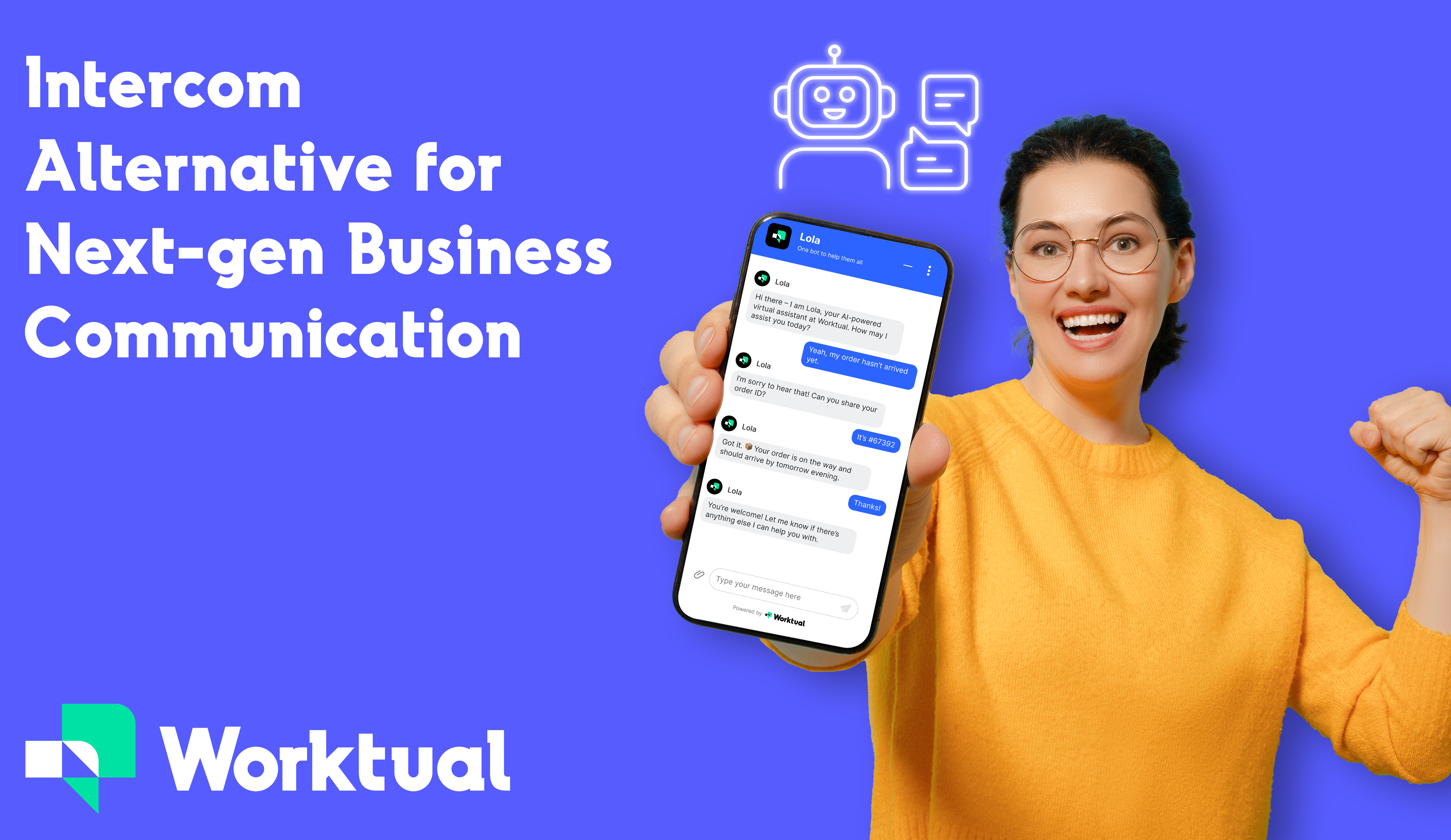
Best Intercom Alternatives for 2026: Top Tools to Improve Customer Support
Assume your business is a growing city. You lay small roads and basic infrastructure to manage the flow of traffic. When you prosper, you attract more ]people, but as the city grows, roads become crowded.
Now, traffic jams slow progress, and what worked perfectly doesn’t anymore. Similarly, many businesses face such issues as they scale while using Intercom. While Intercom has come a long way from being a simple messaging tool to an AI-powered customer service platform, it’s still built for the city with smaller roads.

Voicebots vs Voice AI Agents: Enterprise Customer Service in 2026
Customer support becomes complicated when queries accumulate and responses slow down.
With frustrated customers quitting on you and agents feeling exhausted trying to retain them, the situation is going beyond your control. As issues increase, you feel trapped, with no clear way to regain control.


