
Worktual’s AI-Native Cognitive Data Platform for Retail: Solving Fragmented Customer Journeys, Cart Abandonment, and Inconsistent Personalization

Insights / Worktual’s AI-Native Cognitive Data Platform for Retail: Solving Fragmented Customer Journeys, Cart Abandonment, and Inconsistent Personalization

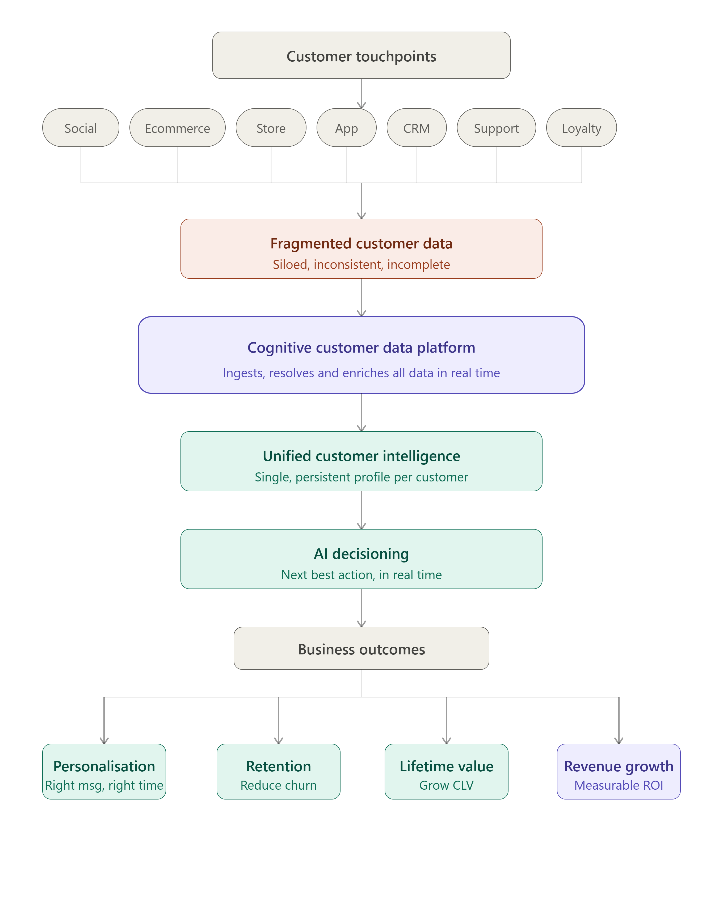
Table of Contents
Retail organizations operate in an increasingly complex environment where customer expectations, digital engagement behavior, and omnichannel commerce continue to evolve rapidly. Customers now interact with brands across ecommerce websites, mobile applications, physical stores, loyalty programmes, social commerce platforms, marketplaces, customer support systems, and conversational interfaces before making purchase decisions. However, many retailers still operate with disconnected customer data environments that limit visibility into customer intent, behavioral patterns, and engagement activity. As a result, customer journeys become fragmented, personalization weakens, and conversion opportunities are frequently lost across the retail lifecycle.
These challenges directly affect commercial performance and long-term customer value. High cart abandonment, inconsistent engagement, delayed decision-making, and generic marketing experiences continue to reduce conversion efficiency across retail operations. Customer data spread across customer relationship management (CRM) systems, ecommerce platforms, loyalty tools, support systems, and marketing applications often creates duplicate records and disconnected experiences. Without unified intelligence, retailers struggle to activate relevant engagement at the right moment.
Worktual addresses these challenges through a consultancy-led, bespoke Cognitive Customer Data Platform powered by AI-native unified intelligence. Unlike conventional customer data platforms that primarily aggregate information for reporting, Worktual’s Cognitive CDP connects behavioral signals, engagement activity, service interactions, purchase history, and lifecycle data into one continuously evolving intelligence layer. This enables retailers to understand what happened, identify why it happened, and reliably anticipate what is likely to happen next—improving customer visibility, personalizing engagement, reducing cart abandonment, strengthening retention, and driving scalable omnichannel retail growth.
- What is a Cognitive Customer Data Platform and what it means for retail customer intelligence and growth
- Retail pain points affecting customer journeys, cart abandonment, and personalization
- Solutions retailers need to improve omnichannel engagement and customer lifecycle performance
- Impact, ROI, and revenue gains from Cognitive Customer Data Platforms in retail
- Why Worktual works for retail organizations
- FAQs
What is a Cognitive Customer Data Platform and what it means for retail customer intelligence and growth
The retail customer journey has become increasingly dynamic and omnichannel. Worktual’s Cognitive Customer Data Platform helps retailers unify customer interactions into one intelligent customer view that understands what happened, identifies why it happened, and reliably anticipate what is likely to happen next. It supports real-time personalization, predictive engagement, stronger retention, and scalable retail growth through connected unified intelligence and AI-native customer lifecycle management.
Beyond centralizing customer information, Worktual’s Cognitive CDP functions as a continuously learning intelligence layer capable of interpreting behavioral intent, contextual engagement patterns, and evolving customer journeys in real time. Rather than relying solely on static reporting or historical segmentation, Worktual enables retailers to move toward inference-driven decision making where AI evaluates behavioral signals, predicts likely outcomes, and recommends next-best actions across the customer lifecycle. This creates a stronger foundation for adaptive retail engagement, contextual personalization, and intelligent omnichannel orchestration across ecommerce, loyalty, conversational AI, CRM, and customer service environments.
Worktual’s Cognitive CDP connects customer data, transactional history, engagement activity, behavioral signals, and lifecycle interactions into one continuously updated intelligence environment. Instead of operating through disconnected ecommerce platforms, CRM systems, loyalty programmes, and marketing applications, retailers gain a unified source of customer intelligence. This improves visibility across browsing behavior, purchase patterns, loyalty participation, retention signals, and revenue opportunities while enabling faster decision-making and more coordinated engagement execution.
Retail challenges affecting customer journeys, cart abandonment, and personalization
Retail organizations face increasing pressure to deliver highly personalised and seamless customer experiences across multiple channels. However, many retailers continue to struggle with fragmented customer journeys where browsing activity, purchase behavior, loyalty engagement, and customer support interactions remain disconnected. Customers frequently move across ecommerce websites, mobile applications, social commerce channels, physical stores, and support systems without continuity in engagement. This weakens customer visibility and limits retailers’ ability to personalise interactions effectively.
Cart abandonment remains one of the largest revenue leakage challenges in retail. Customers often abandon purchases due to checkout friction, delayed communication, or lack of personalised follow-up engagement. Generic remarketing campaigns frequently fail to reflect real customer intent or behavioral context.
Data fragmentation further compounds these challenges. Customer information is often spread across ecommerce platforms, CRM systems, loyalty programmes, customer support tools, marketing applications, and in-store systems. Without Worktual’s Cognitive Customer Data Platform, retailers continue to face disconnected customer experiences, weaker retention, and reduced long-term customer value.
Solutions retailers need to improve omnichannel engagement and customer lifecycle performance
Retailers increasingly require customer intelligence systems capable of preserving customer context and behavioral continuity across multiple channels and interactions. Traditional retail systems often suffer from fragmented customer memory where intent, engagement history, and lifecycle context are lost between platforms. Worktual’s Cognitive Customer Data Platform addresses this challenge through unified customer intelligence and continuously evolving behavioral memory across ecommerce, messaging, customer support, loyalty systems, conversational AI, and physical retail environments. This enables Worktual to support more adaptive engagement strategies and stronger customer continuity across the retail lifecycle.
Improving retail performance requires a unified intelligence layer rather than disconnected operational tools. Worktual’s Cognitive CDP combines ecommerce activity, transactional behavior, loyalty engagement, support interactions, marketing activity, and in-store engagement into one continuously evolving customer profile. This enables retailers using Worktual AI to gain stronger visibility into customer intent, behavioral patterns, product affinity, and lifecycle opportunities while improving decision-making speed and engagement coordination across digital and physical channels.
Worktual AI further strengthens retail engagement through intelligent orchestration, behavioral segmentation, workflow automation, conversational AI, and omnichannel communication capabilities. Worktual’s Cognitive CDP and Customer Value Management framework help retailers improve customer engagement precision, reduce cart abandonment, increase repeat purchases, strengthen retention, and drive scalable retail revenue growth through connected intelligence and AI-native lifecycle management.
Impact, ROI, and revenue gains from Cognitive Customer Data Platforms in retail
The commercial impact of Worktual’s Cognitive Customer Data Platform in retail is closely linked to improvements in customer visibility, engagement precision, and lifecycle orchestration. By unifying customer journeys and behavioral intelligence through Worktual AI-driven retail intelligence, retailers can improve conversion rates and reduce cart abandonment more effectively. Real-time behavioral engagement and personalised interventions can contribute to a 10–25% improvement in digital engagement performance while reducing friction across ecommerce journeys. Worktual also helps retailers improve behavioral targeting, increase customer relevance, and reduce inefficient promotional spend across omnichannel retail environments.
Additional commercial value through Worktual comes from stronger customer retention and repeat purchase performance. Worktual’s AI-driven segmentation and predictive retail intelligence help retailers identify churn risks, product affinity patterns, and high-value customer opportunities earlier. Real-time next-best-action capabilities support upsell opportunities, personalised recommendations, loyalty engagement, and retention campaigns with greater timing precision. This enables retailers using Worktual to improve repeat purchases and strengthen customer lifetime value across retail portfolios.
Operational efficiency provides another layer of value through Worktual AI-native workflow orchestration and automation. Worktual helps retailers improve coordination across marketing, ecommerce, customer support, and loyalty operations while scaling customer engagement, improving omnichannel consistency, and supporting sustainable retail revenue growth.
Why Worktual works for retail organizations
Unlike conventional customer data platforms that primarily aggregate information for reporting, Worktual’s Cognitive Customer Data Platform is designed to support intelligent retail decision-making across the full customer lifecycle. Worktual continuously interprets behavioral context, engagement history, customer intent signals, and operational data to help retailers move from descriptive analytics toward predictive and prescriptive customer engagement. This enables retail leadership teams to deliver more coordinated, context-aware, and adaptive retail experiences while reducing fragmentation across customer-facing systems and engagement workflows.
Worktual approaches customer engagement, behavioral intelligence, and lifecycle performance as one connected retail ecosystem rather than isolated operational functions. In modern retail environments, ecommerce engagement, loyalty participation, customer support, campaign activation, product discovery, and retention are deeply interconnected.
Worktual helps retailers unify these functions into one intelligence-driven operating environment focused on measurable customer and revenue outcomes. This improves alignment between engagement quality, operational efficiency, customer retention, and long-term retail growth priorities.
Worktual’s consultancy-led approach evaluates fragmented customer journeys, weak personalization, cart abandonment patterns, delayed engagement, and operational bottlenecks across the retail lifecycle. At the centre of this model is Worktual’s Cognitive CDP, which unifies customer behavior, transactional activity, and engagement signals into one continuously evolving unified intelligence layer, enabling retailers to improve conversion performance, strengthen retention, increase repeat purchases, and drive scalable omnichannel retail growth.
FAQs
1. What is a Cognitive Customer Data Platform (CDP)?
A Cognitive Customer Data Platform connects customer data, behavioral signals, transactional activity, and engagement interactions into one intelligent retail ecosystem. Unlike traditional customer data platforms, Cognitive CDPs continuously learn from customer behavior using AI-driven intelligence to improve personalization, engagement precision, and customer lifecycle management across retail channels.
2. How is a Cognitive CDP different from a traditional CDP?
Traditional CDPs primarily centralise customer data for reporting and segmentation, while Worktual’s Cognitive Customer Data Platform adds AI-native unified intelligence, predictive analytics, semantic customer memory, and real-time behavioral decisioning. Worktual’s Cognitive CDP helps retailers move beyond static data management toward intelligent customer engagement and adaptive omnichannel retail execution.
3. Why do retailers need Worktual’s Cognitive Customer Data Platform?
Retailers need Worktual’s Cognitive Customer Data Platform because customer journeys have become highly fragmented across ecommerce, mobile, social commerce, loyalty programmes, customer support, and physical stores. Worktual’s Cognitive CDP helps unify these interactions into one connected unified intelligence layer, improving customer visibility, reducing cart abandonment, and enabling real-time personalised engagement.
4. How does Worktual’s Cognitive Customer Data Platform create unified customer profiles?
Worktual’s Cognitive Customer Data Platform creates unified customer profiles by connecting behavioral data, transactional history, loyalty engagement, browsing activity, customer service interactions, and omnichannel engagement into one continuously updated customer view. Worktual enables retailers to activate this intelligence in real time through AI-driven customer engagement and lifecycle orchestration capabilities.
5. Can Worktual’s Cognitive Customer Data Platform help reduce cart abandonment?
Yes, Worktual’s Cognitive Customer Data Platforms can help reduce cart abandonment. They do this by identifying behavioral signals, engagement friction, and purchase intent earlier in the customer journey. Worktual’s AI-driven retail intelligence enables retailers to trigger personalised cart recovery journeys, contextual recommendations, behavioral nudges, and real-time customer engagement strategies that improve conversion outcomes.
6. How does unified intelligence AI improve retail customer personalization?
Unified intelligence AI improves retail personalization by analysing customer behavior, product affinity, purchase patterns, and engagement activity continuously in real time. Worktual uses predictive intelligence, behavioral segmentation, and next-best-action capabilities to help retailers deliver more relevant offers, recommendations, messaging, and customer experiences across digital and physical retail channels.
7. Why is omnichannel orchestration important in retail?
Omnichannel orchestration is important because modern retail customers interact across multiple touchpoints before completing purchases. Without orchestration, engagement becomes fragmented and inconsistent. Worktual enables retailers to coordinate customer journeys, communication, loyalty engagement, and lifecycle execution consistently across ecommerce, mobile, messaging, customer support, and physical store environments.
8. How is Worktual different from standard retail customer data platforms?
Worktual differs from standard retail customer data platforms because it combines consultancy-led retail transformation, AI-native customer intelligence, lifecycle orchestration, Customer Value Management, and omnichannel engagement into one connected retail operating ecosystem. Rather than functioning as a static customer database, Worktual’s Cognitive CDP continuously learns, predicts, and activates intelligent retail engagement designed to improve conversion, retention, and long-term customer value.
9. How safe is Worktual AI?
Worktual uses proprietary AI you can trust to protect retail customer data, with security and compliance embedded into the core of the platform. From access controls to data handling and processing, every layer is designed to safeguard sensitive information while enabling confident, uninterrupted operation.
Related Posts

Unified Intelligence AI for Healthcare: Improving Patient Access, Engagement, and Revenue Performance
Healthcare providers are managing an increasingly complex environment where operational efficiency, patient access, and revenue performance are tightly interconnected. Rising patient expectations, increasing administrative burdens, and workforce shortages continue to place pressure on both clinical and non-clinical teams. Patients now expect immediate responses, seamless scheduling, and consistent communication across channels, yet many healthcare systems still rely on fragmented processes and delayed engagement. These gaps result in missed appointments, underutilized capacity, and inconsistent patient care experiences that directly impact both outcomes and financial performance.

Unified Intelligence AI for Technology: Accelerating Product Adoption, Customer Retention, Expansion Revenue
Technology companies operate in a market defined by rapid innovation cycles, intense competition, rising customer expectations, and increasing pressure to grow efficiently. Technology buyers worldwide expect intuitive onboarding, immediate value, responsive support, and continuous product improvement. At the same time, many businesses face margin pressure, rising acquisition costs, fragmented systems, and expanding service complexity.

Unified Intelligence AI for Automotive: Elevating Lead Conversion, Strengthening Service Retention, Enhancing Dealer Efficiency
Automotive businesses operate in a market shaped by changing buyer expectations, margin pressure, digital disruption, and growing competition across brands, dealers, and aftermarket providers. Customers now expect rapid responses, transparent pricing, seamless booking, and consistent experiences across websites, showrooms, finance journeys, and service centers. Yet many organizations still rely on fragmented systems, delayed reporting, and disconnected customer journeys. When inquiry handling is slow, handovers are inconsistent, or service engagement is weak, conversion falls and loyalty declines. In this environment, automotive customer lifecycle management has become central to protecting growth, profitability, and long-term customer value today.