Enterprises Don’t Need a Bigger AI Model. They Need Better Customer Context.

Insights / Enterprises Don’t Need a Bigger AI Model. They Need Better Customer Context.

Enterprises Dont-Need Bigger Ai Model Customer-Context

At a recent developer conference, Microsoft CEO Satya Nadella asked whether an organization really needs to own frontier-grade AI to compete at the frontier. It’s a question worth considering as enterprise AI strategies continue to evolve. For a long time, the assumption was simple: the biggest and best-trained model would give a business the biggest advantage.

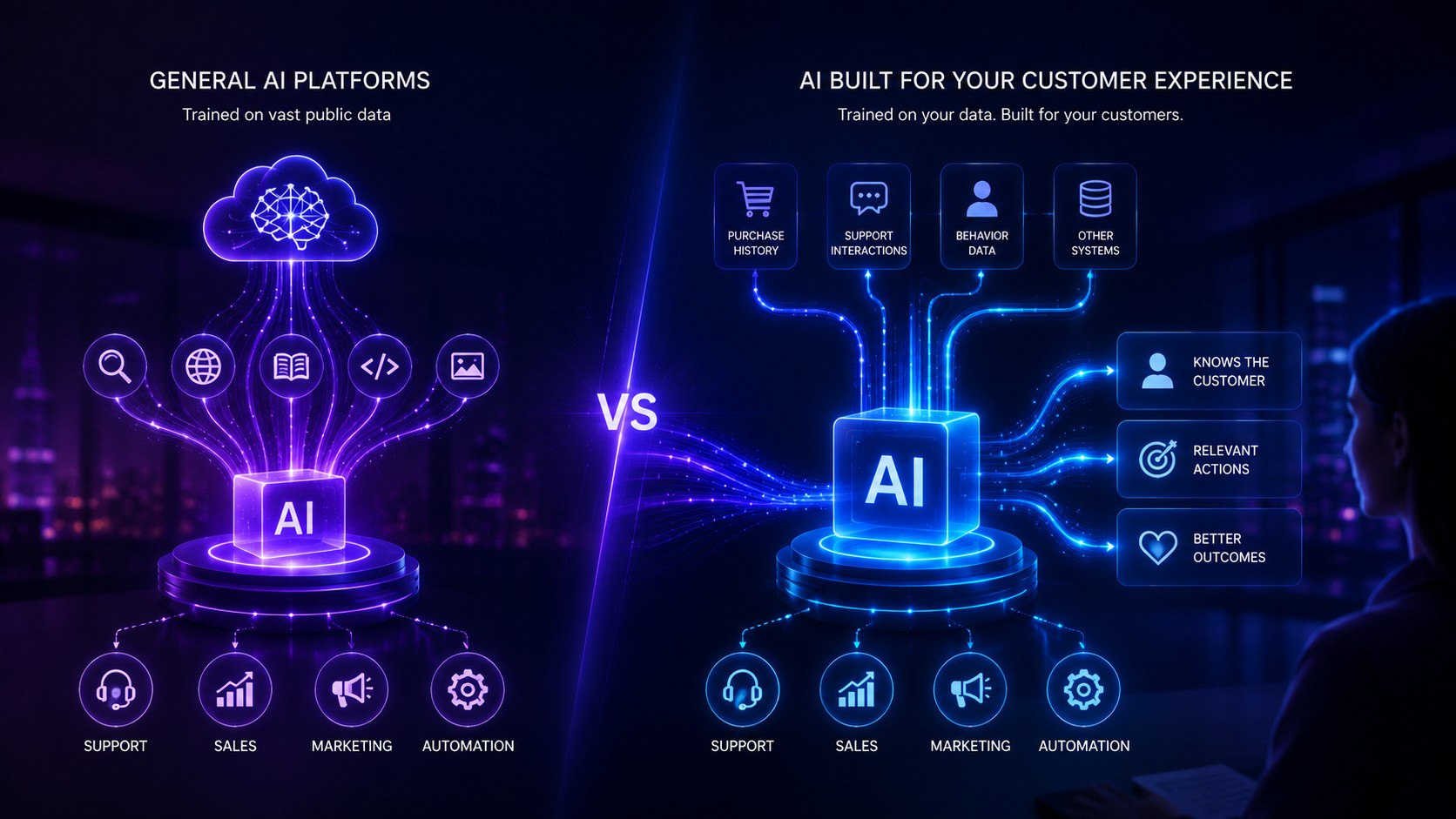
For customer-facing AI, the picture is more complicated. Systems handling support, sales and retention need access to something a general-purpose model doesn’t have on its own: a clear picture of the customer.

The Model Is Becoming the Commodity

MIT researchers recently published a paper titled Meek Models Shall Inherit the Earth. Their research found that smaller, resource-constrained models can gradually close the performance gap with frontier models.

As models become larger, simply adding more computing power produces smaller gains. A model trained with a fraction of the resources can therefore catch up over time.

Gartner’s forecast points in a similar direction. By 2027, organizations are expected to deploy small, task-specific AI models at roughly three times the rate of general-purpose models, according to Gartner’s April 2025 prediction.

The reason is practical. General-purpose models can struggle with tasks that depend heavily on business-specific information. A smaller model trained for a particular task, with the right data behind it, can perform better. For enterprises, this makes customer context an increasingly important part of the AI architecture.

Why This Matters More for Customer-Facing AI Thn Almost Anywhere Else

A general-purpose model may know a huge amount about the world. It doesn’t automatically know anything about a particular business’s customers.

Consider a customer contacting support. The model may understand the customer’s question, but it won’t know that the person has already contacted support twice this week, purchased a particular product six months ago or is showing signs of churn unless that information is available to it.

For customer service, sales and retention, that history can make a major difference. The quality of the response depends on whether the AI can access the information needed to understand the situation.

Microsoft has demonstrated this in a real deployment. A large frontier model was used to generate reasoning traces for specific workflows. Those traces were then used to train a much smaller model.

The smaller model eventually outperformed the frontier model on the business’s actual tasks, while costing much less to run. The result shows the value of combining the right model with the right business context.

What Actually Matters, for Customer AI Specifically

1. A single, current view of the customer. AI needs access to the information that helps it understand the customer. If purchase history sits in one system, support tickets in another and browsing behavior in a third, the AI may only see part of the picture. A unified customer view gives it much more useful context to work with.

2. The ability to change models without rebuilding everything. AI models are evolving quickly. Smaller and more specialised models are becoming increasingly capable, and businesses will have more options to choose from. That makes flexibility important. If customer context is built directly into one model or provider, switching later can mean expensive redevelopment.

Keeping customer context in an independent layer allows businesses to change the underlying model while retaining the intelligence they have built around their customers.

3. Measuring real customer outcomes. Generic AI benchmarks are useful for comparing models, but they don’t tell a business whether its customer AI is actually delivering results.

For example:

  • Did the support interaction resolve the issue?
  • Did a retention offer prevent churn?
  • Did a recommendation lead to a purchase?
  • Did the customer have a better experience?

These outcomes provide a much more useful measure of customer AI performance.

Ai Ecommerce Complete Guide

Where Worktual Fits

Worktual‘s Cognitive CDP and CVM are designed around this approach. Cognitive CDP provides a unified, continuously updated view of the customer, bringing together purchase history, support interactions and behavior across channels.

That context sits as its own layer rather than being tied to one particular AI model. CVM uses that context to support decisions such as retention actions, next-best offers and service responses. Those decisions can then be measured against the outcome they produce.

As new AI models become more capable and cost-effective, businesses can use them without having to rebuild the customer intelligence layer underneath. For an enterprise, that’s an important part of building an AI architecture that can keep evolving.

Conclusion

AI models are improving quickly, and access to powerful models is becoming more widespread. For customer-facing AI, businesses also need to think about what sits around the model.

A model needs access to the right customer history, behavior and business context if it is going to make useful decisions. That makes customer context a core part of the AI architecture, alongside the model itself.

For enterprises, the investment isn’t simply about finding the most powerful model available today. It’s about building a customer intelligence foundation that can work with the models available tomorrow.

Frequently Asked Questions

1. Do enterprises need to build their own AI model to compete?

Increasingly, businesses have more options than building their own frontier model. MIT research shows that smaller models can close the performance gap with larger models over time, while Gartner forecasts that small, task-specific models will be deployed at roughly three times the rate of general-purpose models by 2027.

2. Why does model size matter less for customer-facing AI?

Customer-facing AI needs access to information about the individual customer. A smaller model with the right customer history and business context can perform very effectively on a specific task, while a larger model without that information has less to work with.

3. What should businesses invest in alongside AI models?

Businesses should focus on a unified view of the customer, flexible architecture that allows models to be changed, and measurement based on actual customer outcomes.

4. What happens if customer context is tied to one AI model?

Changing models can become expensive if the customer context has been built directly around a particular model or provider. Keeping that context in an independent layer makes it easier to upgrade or change the underlying AI.

5. How does Worktual apply this approach?

Worktual’s Cognitive CDP keeps unified customer context in its own layer, while CVM uses that context to support and measure customer decisions. This allows the underlying AI models to evolve without requiring the customer intelligence layer to be rebuilt.

Related Posts

AI Native vs AI Powered SaaS

AI-Native vs AI-Powered SaaS: What Is the Difference?

Insurance organizations operate in a complex, regulation-driven, margin-sensitive environment where growth depends on efficient onboarding, strong retention, and effective cross-sell across product lines. AI in insurance is central to this shift, as customers expect seamless digital onboarding journeys, real-time responses, and personalized communication across channels. Whether purchasing a policy, renewing coverage, or managing claims, expectations are shaped by digital-first experiences.

Multi Agent Ai Unified Intelligence

More Agents, Less Intelligence? Why Unified Intelligence is the Next Step for Enterprise

Insurance organizations operate in a complex, regulation-driven, margin-sensitive environment where growth depends on efficient onboarding, strong retention, and effective cross-sell across product lines. AI in insurance is central to this shift, as customers expect seamless digital onboarding journeys, real-time responses, and personalized communication across channels. Whether purchasing a policy, renewing coverage, or managing claims, expectations are shaped by digital-first experiences.

Contact Center Revenue Engine Not Cost Center

Why the Contact Center Is Becoming a Revenue Engine, Not a Cost Center

Healthcare providers are managing an increasingly complex environment where operational efficiency, patient access, and revenue performance are tightly interconnected. Rising patient expectations, increasing administrative burdens, and workforce shortages continue to place pressure on both clinical and non-clinical teams. Patients now expect immediate responses, seamless scheduling, and consistent communication across channels, yet many healthcare systems still rely on fragmented processes and delayed engagement. These gaps result in missed appointments, underutilized capacity, and inconsistent patient care experiences that directly impact both outcomes and financial performance.