

From AI Assistants to AI Agents: How Enterprise AI Is Moving from Answers to Action
Insights / From AI Assistants to AI Agents: How Enterprise AI Is Moving from Answers to Action

Table of Contents
Most enterprise AI conversations still start with a question: what can this system tell us?
That question has driven the last few years of AI adoption, from chatbots to copilots. The more important question now is: what can a system do once it understands a goal, not just a prompt?
That shift matters because AI adoption is moving faster than enterprise-scale execution. According to McKinsey’s State of AI 2025 survey, 62% of organisations are engaging with AI agents in some form — with 39% experimenting with AI agents and 23% scaling agentic AI systems somewhere within their enterprise. However, adoption remains limited within individual functions: no more than 10% of respondents report scaling AI agents in any single business function.
In other words, enterprises are actively exploring AI agents, but many are still working through how to move from individual AI deployments to coordinated intelligence across the organisation.
An assistant tells a team:
“Here are the customers at risk.” An agent says: “These customers are at risk, here is why, and I have initiated the appropriate retention action.”
The difference is not simply intelligence. It is whether the system is connected to the right context, trusted to make decisions, and equipped to act.
From Generative AI to AI Assistants to AI Agents
Not every AI system that responds to a prompt is an agent, and not every chatbot with a name is agentic. The distinction sits in how much a system does independently, and how much decision-making stays with a human.
| Stage | What It Does | Human Involvement |
|---|---|---|
| Generative AI | Creates content, summaries, and responses | Human prompts and evaluates every output |
| AI Assistant / Copilot | Helps users perform tasks and make decisions | Human remains in control throughout |
| AI Agent | Understands a goal, reasons through tasks, and takes action | Human sets objectives and provides oversight |
| Multi-Agent AI | Multiple specialised agents work together on connected tasks | Human governs the overall system |
Each stage adds capability, not just automation. A generative AI tool waits for a prompt every time. An assistant remembers context within a task. An agent can decide what the next task should be. A multi-agent system coordinates several of those decisions across a workflow. Calling a basic FAQ chatbot an “agent” because it uses a large language model skips several real steps in that progression.
What Makes an AI Agent Different?
An AI agent is defined by what it does with a goal, not by which model sits underneath it. Six capabilities separate a genuinely agentic system from an assistant with a more capable interface:
- Understand — interpret the objective, the context, and the user’s actual intent, not just the literal request
- Reason — evaluate available information and determine what needs to happen next
- Plan — break a larger objective into a sequence of smaller steps
- Use tools and systems — access CRM, ticketing, knowledge bases, campaign systems, and APIs directly
- Act — execute the appropriate action, rather than simply recommending it to a human
- Adapt — use the outcome of one action to determine what should happen next
A traditional system can flag that a customer’s issue is unresolved. An AI agent identifies the issue, checks the customer’s history, determines the appropriate resolution, updates the ticket, and escalates to a human only where the situation genuinely requires one.
Where Enterprise AI Agents Are Already Making a Difference
The value shows up fastest in functions with high volume and clear decision logic. Five areas account for most of the credible enterprise deployments today:
- Customer service — understanding intent, resolving common issues, retrieving customer context, updating tickets, and escalating when necessary
- Sales — identifying accounts, researching customer context, recommending next actions, and triggering follow-up
- Marketing — segmenting audiences, reading behaviour and intent, and personalising and optimising campaign actions
- Customer retention — identifying churn signals, determining risk, and triggering the appropriate intervention
- Operations — automating repetitive workflows, moving information between systems, and detecting and escalating exceptions
The common thread across all five is not the technology. It is that each use case depends on the agent seeing accurate, current context before it acts.
Why Enterprises Can't Just Keep Adding Agents
The instinct once an AI agent proves useful in one area is to deploy more agents across more functions.
A customer service agent handles support queries. A sales agent identifies opportunities. A marketing agent recommends campaigns. A retention agent predicts churn risk.
Individually, each agent may perform its role effectively.
The challenge appears when those agents operate from different sources of information. A retail customer who has recently complained about a delayed delivery may appear valuable to a sales agent looking only at purchase history. At the same time, a service agent with access to complaint history may identify that the same customer is at risk of leaving.
Neither agent is necessarily wrong.
They are simply working with different versions of the customer. The same challenge appears across industries:
A bank’s relationship agent may recommend a premium product while a service agent is handling unresolved complaints.
- A telecom sales agent may identify an upgrade opportunity while a support agent knows the customer has experienced repeated service issues.
- An ecommerce recommendation agent may suggest new purchases while a returns agent has identified dissatisfaction patterns.
The problem is not that individual agents lack capability. The problem is that they lack a shared understanding of the customer. This is the practical cost of agent sprawl: fragmented context, inconsistently applied business rules, and increasing governance complexity.
More agents do not automatically mean more intelligence.
The Missing Layer: Shared Intelligence
Agents need more than a capable model and access to tools. They need a shared understanding of the customer and the business context they are acting within, so that two agents working on the same customer reach compatible conclusions rather than competing ones.
A shared intelligence layer brings together:
- Customer data and history
- Behaviour and intent
- Customer value
- Business context
- Decisioning logic
- Relevant rules and permissions
With that layer in place, agents act from the same current understanding of a customer, rather than each building its own partial version of who that customer is. One customer, one context, multiple intelligent actions, rather than multiple, quietly conflicting versions of the same relationship.
From Individual Agents to an Intelligent Enterprise
The architecture underneath agentic AI has moved through four distinct stages:
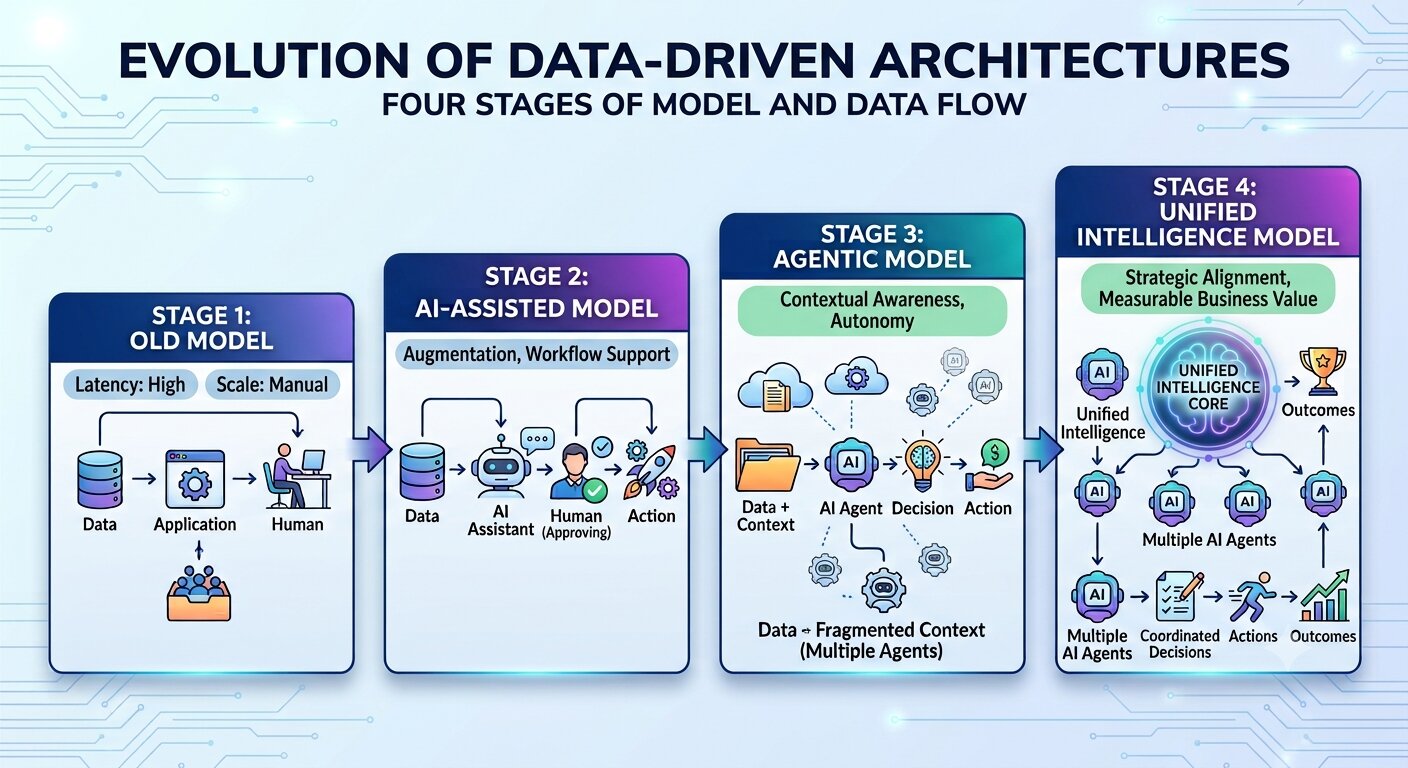
| Evolution Stage | Description | Key Characteristics | Process Flow | Key Bottleneck |
|---|---|---|---|---|
| Stage 1: Old Model | The traditional data processing method. | High latency, manual scale. | Data → Application → Human | Human Bandwidth: Manual entry and decision-making limit processing speeds. |
| Stage 2: AI-Assisted Model | Integrates AI for task support. | Task augmentation, workflow support. | Data → AI Assistant → Human (Approving) → Action | Human Approval: While data is prepared faster, a human must review and approve every step. |
| Stage 3: Agentic Model | Utilizes standalone autonomous AI agents | Contextual awareness, autonomy. | Data + Context → AI Agent → Decision → Action | Fragmented Context: Independent agents lack a unified data source, leading to isolated or conflicting decisions. |
| Stage 4: Unified Intelligence Model | Connects all enterprise intelligence. | Strategic alignment, measurable business value. | Unified Intelligence → Multiple AI Agents → Coordinated Decisions → Actions → Outcomes | None (Unified Data Core): Data and decisions are coordinated across all systems, removing information silos. |
Each stage removes a bottleneck the previous one had. The old model bottlenecked on human bandwidth. The AI-assisted model still bottlenecked on a human approving every action. The agentic model solves that, but bottlenecks on fragmented context once more than one agent is involved. Only the last stage, coordinated agents drawing on one shared intelligence layer, removes all three.
Where Worktual Fits
Worktual approaches agentic AI through two connected layers: intelligence and action.
The intelligence layer provides the shared context that AI systems need to make consistent decisions. Worktual’s Cognitive CDP brings together customer information from connected channels and systems into a unified customer profile, creating a single view of customer context.
On top of this, Customer Value Management (CVM) applies customer value scoring, predictive insights and decisioning to determine relevant next actions.
The action layer enables those decisions to be executed through Worktual’s AI-Native solutions, including Lola Chat and Voicebot, AI CRM, AI Contact Centre, AI Campaigns and AI Ticketing.
The key difference is not simply having multiple AI capabilities.
It is enabling those capabilities to work from a shared intelligence foundation — allowing customer-facing AI systems to move from isolated interactions towards coordinated decisions and actions.
For enterprises, this means AI agents are not operating as disconnected systems, each creating their own view of the customer. Instead, they can work from a common understanding of customer context, business objectives and relevant rules.
The result is a shift from multiple AI tools delivering separate actions to connected AI systems delivering coordinated outcomes.
What Enterprises Should Consider Before Deploying AI Agents
Before adding another agent to the stack, six questions are worth answering honestly:
- What data can the agent access? Is the context complete and current, or partial and stale?
- What can the agent actually do? Can it execute actions, or only make recommendations for a human to act on?
- What systems can it work with? CRM, ticketing, contact centre, and campaign platforms, specifically.
- How is human oversight handled? Where should a human approve, intervene, or take over entirely?
- How are decisions governed? Permissions, compliance, auditability, and business rules all need clear ownership.
- How will success be measured? Beyond the number of agents deployed: resolution time, conversion, retention, customer experience, cost to serve, and revenue impact.
An enterprise that cannot answer most of these before deployment is likely to end up with more agents and the same fragmentation problem, just automated.

The Future: From AI Agents to Agentic Enterprises
Enterprises will keep moving from isolated AI use cases toward connected AI systems. Agents will become more specialised rather than more general-purpose, and specialised agents will increasingly need to collaborate rather than operate in isolation. As the number of agents in an organisation grows, shared context and governance stop being nice-to-haves and become the constraint that determines whether any of it actually works.
The competitive advantage will not come from which enterprise has the most agents. It will come from how intelligently those agents work together, and how effectively an organisation turns intelligence into action.
The next phase of enterprise AI is not about getting better answers. It is about turning intelligence into coordinated action.
Frequently Asked Questions
1. What is the difference between an AI assistant and an AI agent?
An AI assistant helps a human complete a task, with the human directing each step and remaining in control throughout. An AI agent understands a goal, reasons through what needs to happen, and takes action independently, with a human setting objectives and providing oversight rather than approving every step.
2. What makes an AI system truly agentic?
A genuinely agentic system understands an objective, reasons about what needs to happen, plans the steps required, uses tools and systems directly, executes actions rather than only recommending them, and adapts based on the outcome. A conversational interface alone does not make a system agentic.
3. How are enterprises using AI agents?
Enterprises are deploying AI agents most successfully in customer service, sales, marketing, customer retention, and operations, typically for high-volume, well-defined tasks such as resolving common issues, identifying churn risk, moving information between systems, and escalating exceptions, with human oversight throughout.
4. Can multiple AI agents work together?
Yes, in a multi-agent model, several specialised agents work on connected tasks under overall human governance. This only functions well when the agents share consistent customer context and business rules; otherwise, agents can reach individually reasonable but collectively conflicting conclusions.
5. Why do AI agents need shared customer context?
Without shared context, different agents see different slices of customer data and can reach conclusions that are technically correct but contradictory, such as one agent flagging a customer as high-risk while another recommends an upsell. Shared context lets agents act from one current understanding of the customer.
6. What is Unified Intelligence?
Unified Intelligence refers to an architecture in which customer data, history, behaviour, value, and business rules are brought into one shared layer that multiple AI agents and systems can draw on, so that coordinated decisions and actions are based on one current version of the customer, not several.
7. How does Worktual support agentic AI?
Worktual separates intelligence from action: Cognitive CDP unifies customer data and context, and CVM applies value scoring and decisioning on top of it. AI products including Lola, AI CRM, AI Contact Centre, AI Campaigns, and AI Ticketing then act from that shared intelligence layer.
8. What should enterprises consider before deploying AI agents?
Before deployment, enterprises should clarify what data the agent can access, whether it can execute actions or only recommend them, which systems it connects to, how human oversight is handled, how decisions are governed, and how success will be measured beyond the number of agents in use.
Related Posts
AI-Native vs AI-Powered SaaS: What Is the Difference?
Insurance organizations operate in a complex, regulation-driven, margin-sensitive environment where growth depends on efficient onboarding, strong retention, and effective cross-sell across product lines. AI in insurance is central to this shift, as customers expect seamless digital onboarding journeys, real-time responses, and personalized communication across channels. Whether purchasing a policy, renewing coverage, or managing claims, expectations are shaped by digital-first experiences.

AI-Native Customer Experience Architecture: From Data to Autonomous Action
Insurance organizations operate in a complex, regulation-driven, margin-sensitive environment where growth depends on efficient onboarding, strong retention, and effective cross-sell across product lines. AI in insurance is central to this shift, as customers expect seamless digital onboarding journeys, real-time responses, and personalized communication across channels. Whether purchasing a policy, renewing coverage, or managing claims, expectations are shaped by digital-first experiences.

One Customer Profile, Four Solutions, One Decision
Insurance organizations operate in a complex, regulation-driven, margin-sensitive environment where growth depends on efficient onboarding, strong retention, and effective cross-sell across product lines. AI in insurance is central to this shift, as customers expect seamless digital onboarding journeys, real-time responses, and personalized communication across channels. Whether purchasing a policy, renewing coverage, or managing claims, expectations are shaped by digital-first experiences.


