

How to Turn E-commerce Traffic into Long-Term Revenue with Worktual’s AI Chatbot, AI Omnichannel Contact Center & Intelligent Ticketing
Insights / How to Turn E-commerce Traffic into Long-Term Revenue with Worktual’s AI Chatbot, AI Omnichannel Contact Center & Intelligent Ticketing

Table of Contents
Every online order creates a customer journey, and every customer journey creates support requests. As e-commerce businesses scale, customer interactions multiply across Shopify, Big Commerce, marketplaces such as Amazon and Walmart Marketplace, and brick-and-mortar locations. Delivering fast, consistent support has become increasingly difficult, turning
Common customer service challenges include:
- High volumes of order tracking, return, refund, and exchange requests.
- Customer conversations scattered across multiple communication channels.
- Manual ticket creation, routing, and prioritisation that slows response times.
- Agents switching between systems to access customer history and order information.
- Repetitive enquiries that consume valuable support resources.
- Limited visibility into customer context, resulting in inconsistent service experiences.
Traditional ticketing systems were designed to log and assign customer requests, but they struggle to manage today’s omnichannel support environment. Without AI-driven automation and unified customer intelligence, support teams spend more time managing tickets than resolving customer issues. Worktual transforms ticketing into an intelligent service operation with AI Chatbot, AI Omnichannel Contact Center, and Intelligent Ticketing working together to automate support, provide complete customer context, and deliver faster resolutions that go Beyond Expectations.
- Why Traditional Ticketing Systems Fall Short in E-commerce
- Why Customer Service Has Become an E-commerce Growth Challenge
- How a Unified Intelligence Platform Transforms E-commerce Customer Support
- Why Worktual for AI-Native Intelligent Ticketing Built on a Unified Intelligence Platform
- Transforming Customer Lifetime Value with AI-Native Intelligence Ticketing
- FAQs
Why Traditional Ticketing Systems Fall Short in E-commerce
Customer support has evolved from managing tickets to managing customer experiences. While traditional ticketing systems help organise customer requests, they often lack the intelligence needed to meet modern e-commerce expectations. AI-Native ticketing transforms support by automating routine tasks, providing complete customer context, and enabling faster, more personalised resolutions.
| Traditional Ticketing | AI-Native Intelligent Ticketing |
|---|---|
| Logs and assigns customer requests | Understands customer intent and automates ticket handling |
| Manual ticket classification and routing | AI automatically classifies, prioritises, and routes tickets |
| Customer conversations remain siloed across channels | Unifies conversations across chat, email, WhatsApp, voice, and social media |
| Agents search multiple systems for customer information | Provides a complete customer profile and interaction history in one place |
| Handles every enquiry through human agents | AI Chatbot resolves routine enquiries before tickets are created |
| Reactive support based on incoming requests | Proactive support using AI, automation, and customer insights |
| Longer response and resolution times | Faster first response and quicker issue resolution |
| Higher operational costs due to manual effort | Reduced cost-to-serve through intelligent automation |
| Limited reporting on support performance | Real-time insights into customer issues, agent productivity, and service performance |
| Focuses on ticket management | Focuses on customer outcomes, satisfaction, and loyalty |
The difference is not simply automation; it’s intelligence. AI-Native ticketing enables businesses to resolve issues faster by understanding customer context, reducing repetitive work, and connecting every interaction across the customer journey. Instead of managing tickets in isolation, support teams deliver personalised service that improves operational efficiency, customer satisfaction, and long-term loyalty.
Why Customer Service Has Become an E-commerce Growth Challenge
Customer service is no longer just a post-purchase function. It influences conversion, customer satisfaction, repeat purchases, and long-term profitability. Yet many e-commerce businesses continue to rely on disconnected support systems that create operational inefficiencies across the customer journey.
The biggest challenges include:
- Rising customer acquisition costs that make retaining existing customers more important than ever.
- High cart abandonment rates, often between 60–75%, driven by unanswered questions, purchase hesitation, and delayed support.
- Fragmented customer information spread across commerce platforms, CRM systems, helpdesks, and communication channels.
- Large volumes of repetitive customer enquiries increasing support costs and reducing agent productivity.
- Limited customer context, making it difficult to personalise support or resolve issues quickly.
- Poor visibility into customer interactions, leading to inconsistent experiences and missed opportunities for retention and upselling.
Today’s ecommerce businesses face more than increasing support tickets. Rising customer acquisition costs, intense marketplace competition, shrinking profit margins, and higher customer expectations mean every interaction must deliver value. At the same time, customers move seamlessly between websites, marketplaces, mobile apps, WhatsApp, email, and social media. When these interactions are managed in separate systems, businesses struggle to understand the complete customer journey.
As ecommerce operations grow, simply hiring more support agents is no longer a sustainable strategy. Growth requires better visibility into customer behaviour, faster decision-making, and AI-powered automation that reduces manual work while improving customer experiences.
These challenges are closely connected. Fragmented customer data, disconnected support channels, and manual ticketing processes prevent businesses from delivering the fast, personalised experiences customers expect. Solving these issues requires more than automating support; it requires a unified intelligence layer that connects every customer interaction, every ticket, and every business function into a single ecosystem.
How a Unified Intelligence Platform Transforms E-commerce Customer Support
AI-native Intelligent Ticketing is most effective when it operates within a unified customer intelligence ecosystem. Every customer interaction; whether it’s browsing a product, abandoning a cart, chatting with a virtual assistant, placing an order, or raising a support request, creates valuable signals about customer intent and behaviour. Rather than storing this information across disconnected CRM, helpdesk, marketing, and commerce platforms, Unified Customer Intelligence brings every interaction together into a single, real-time customer profile. This shared intelligence ensures every ticket is enriched with the complete customer context, enabling faster resolutions, personalised service, and better business decisions across sales, marketing, and customer support.
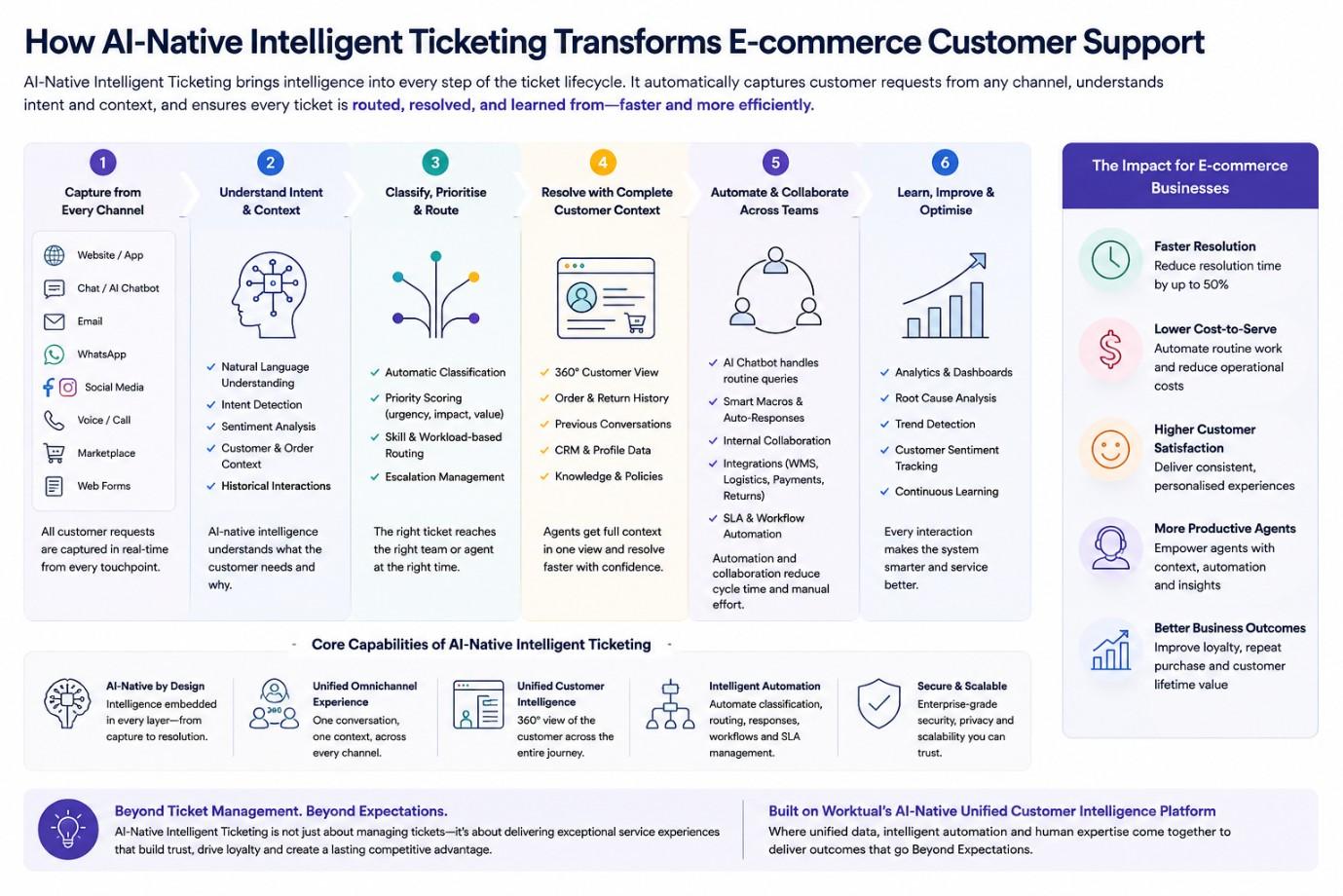
As every customer interaction flows into a shared intelligence layer, support teams no longer work with isolated tickets; they work with complete customer stories. Intelligent Ticketing can automatically identify customer intent, prioritise requests, recommend the next best action, and route cases based on customer value, previous interactions, and business rules. The result is a connected service operation that reduces manual effort, accelerates resolution times, improves agent productivity, and delivers more consistent customer experiences.

Why Worktual for AI-Native Intelligent Ticketing Built on a Unified Intelligence Platform
Worktual brings customer engagement, service operations, and customer intelligence together in a single AI-Native Unified Customer Intelligence platform, enabling e-commerce businesses to deliver connected customer experiences across every stage of the customer journey.
Worktual Combines AI Chatbot, AI Contact Center, Intelligent Ticketing, CDP, CVM & Campaign Intelligence
- AI Chatbot – Acts as a guided selling assistant, helping customers discover products, answer questions, overcome purchase hesitation, and complete purchases. It also resolves routine post-purchase enquiries, reducing ticket volumes before they reach support teams.
- AI Omnichannel Contact Center – Unifies conversations across chat, email, WhatsApp, voice, and social media into a single workspace, ensuring every interaction is connected and every customer receives a consistent experience.
- Intelligent Ticketing – Automatically captures, classifies, prioritises, routes, and tracks customer requests while providing agents with complete customer context to accelerate resolution and improve service quality.
- Cognitive Customer Data Platform (CDP) – Creates a unified customer profile by combining behavioural, transactional, and service data, giving every customer interaction the context needed for personalised support.
- Customer Value Management (CVM) – Identifies high-value customers, churn risks, and engagement opportunities, helping businesses prioritise service and maximise customer lifetime value.
- Campaign & Lifecycle Intelligence – Activates customer insights through personalised onboarding, retention, re-engagement, and loyalty journeys that strengthen relationships long after a support interaction has ended.
Together, these capabilities transform ticketing from a standalone support function into an AI-Native Unified Customer Intelligence ecosystem that improves operational efficiency, enhances customer experiences, and drives long-term business growth.
Transforming Customer Lifetime Value with AI-Native Intelligence Ticketing
Customer service is no longer just about resolving issues; it’s about building lasting customer relationships. As e-commerce businesses continue to grow across channels, traditional ticketing systems are no longer equipped to meet rising customer expectations or support increasingly complex service operations.
AI-Native Intelligent Ticketing enables businesses to move beyond reactive support by connecting customer interactions, service workflows, and customer intelligence into a single ecosystem. With complete customer context, intelligent automation, and unified engagement, every interaction becomes an opportunity to improve operational efficiency, strengthen customer loyalty, and maximise customer lifetime value.
Worktual helps e-commerce businesses make this transition with an AI-Native Unified Customer Intelligence platform that brings together AI Chatbot, AI Omnichannel Contact Center, Intelligent Ticketing, CDP, Customer Value Management, and Lifecycle Intelligence. The result is a connected customer service operation that scales with your business, delivers measurable outcomes, and creates experiences that go Beyond Expectations.
FAQs
1. What is AI-Native Intelligent Ticketing?
AI-Native Intelligent Ticketing is a customer service solution that uses artificial intelligence as its foundation to automatically capture, classify, prioritise, and route customer requests. Unlike traditional ticketing systems, it combines automation with unified customer intelligence to provide complete context for every interaction and accelerate issue resolution
2. How is AI-Native Intelligent Ticketing different from traditional ticketing systems?
Traditional ticketing systems primarily record and assign customer requests. AI-Native Intelligent Ticketing understands customer intent, automates repetitive tasks, intelligently routes cases, and provides agents with a complete customer view, resulting in faster resolutions and improved service efficiency.
3. How does AI-Native Intelligent Ticketing improve e-commerce customer service?
It automates routine enquiries, reduces manual ticket handling, provides complete customer context, and ensures customers receive faster, more consistent support across every communication channel. This improves customer satisfaction while reducing operational costs.
4. What role does Unified Customer Intelligence play in ticketing?
Unified Customer Intelligence connects customer interactions, purchase history, support conversations, behavioural data, and CRM information into a single customer profile. This enables Intelligent Ticketing to personalise support, prioritise requests more effectively, and improve decision-making throughout the customer journey.
5. Can AI Chatbots reduce customer support tickets?
Yes. AI Chatbots can resolve common customer enquiries such as product information, order tracking, delivery updates, returns, refunds, and FAQs before they require human intervention. This reduces ticket volumes and allows support teams to focus on more complex customer issues.
6. Why is an AI Omnichannel Contact Center important for e-commerce businesses?
Customers interact across websites, email, WhatsApp, social media, voice, and other digital channels. An AI Omnichannel Contact Center consolidates these conversations into a single workspace, ensuring every interaction is connected and providing agents with complete conversation history regardless of where the customer reaches out.
7. How does Intelligent Ticketing improve operational efficiency?
Intelligent Ticketing automates ticket creation, classification, prioritisation, routing, and workflow management while supporting SLA compliance. This reduces manual effort, improves agent productivity, shortens resolution times, and lowers the overall cost-to-serve.
8. Why should e-commerce businesses choose Worktual for Intelligent Ticketing?
Worktual combines AI Chatbot, AI Omnichannel Contact Center, Intelligent Ticketing, Customer Data Platform (CDP), Customer Value Management (CVM), and Lifecycle Intelligence within a single AI-Native Unified Customer Intelligence platform. This connected approach helps e-commerce businesses deliver faster customer service, improve operational efficiency, strengthen customer loyalty, and maximise customer lifetime value.

Related Posts

One Customer Profile, Four Solutions, One Decision
Insurance organizations operate in a complex, regulation-driven, margin-sensitive environment where growth depends on efficient onboarding, strong retention, and effective cross-sell across product lines. AI in insurance is central to this shift, as customers expect seamless digital onboarding journeys, real-time responses, and personalized communication across channels. Whether purchasing a policy, renewing coverage, or managing claims, expectations are shaped by digital-first experiences.

The Enterprise Software Shift in 2026: What the Data Actually Shows
Insurance organizations operate in a complex, regulation-driven, margin-sensitive environment where growth depends on efficient onboarding, strong retention, and effective cross-sell across product lines. AI in insurance is central to this shift, as customers expect seamless digital onboarding journeys, real-time responses, and personalized communication across channels. Whether purchasing a policy, renewing coverage, or managing claims, expectations are shaped by digital-first experiences.

AI-Native Customer Experience Architecture: From Data to Autonomous Action
Insurance organizations operate in a complex, regulation-driven, margin-sensitive environment where growth depends on efficient onboarding, strong retention, and effective cross-sell across product lines. AI in insurance is central to this shift, as customers expect seamless digital onboarding journeys, real-time responses, and personalized communication across channels. Whether purchasing a policy, renewing coverage, or managing claims, expectations are shaped by digital-first experiences.


