Solutions
Resources
Let's talk

From Anonymous Visitor to Qualified Lead: Building a Real-Time Customer Journey with a CDP and Web Tracking

Insights / From Anonymous Visitor to Qualified Lead: Building a Real-Time Customer Journey with a CDP and Web Tracking

CDP Web Tracking for Lead Qualification

The Buying Journey Starts Before the First Conversation

A potential buyer visits your website, explores solutions, reviews pricing, and leaves without requesting a demo.

A week later, the buyer returns, downloads a case study, and examines integration capabilities.

Your analytics records these interactions. But does your business recognize their connection?

CDP and web tracking can connect permitted website behavior with customer information, creating context for better lead qualifications and more relevant sales conversations.

The opportunity isn’t identifying every visitor. It’s recognizing meaningful buying signals before the first sales interaction.

Why Anonymous Visitors Matter More Than Ever

B2B buyers increasingly research independently before engaging vendors.

According to Gartner’s March 2026 research, 67% of B2B buyers prefer a sales-representative-free buying experience, based on a survey of 646 buyers conducted in 2025.

Meanwhile, McKinsey’s 2026 Global B2B Pulse Survey found that buyers use an average of ten channels throughout their purchasing journey. The research involved nearly 4,000 decision-makers across 13 countries.

These findings highlight a challenge: buying journeys develop across multiple interactions before prospects identify themselves.

Yet website analytics, marketing platforms, and CRM records often remain disconnected.

Sales teams may receive an inquiry without understanding the research and engagement that preceded it.

How Do Web Tracking and a CDP Work Together?

Anonymous visitor tracking captures permitted website interactions before visitors provide identifying information.

These interactions may include:

  • Product exploration and pricing page visits.
  • Content downloads and repeat sessions.
  • Navigation patterns and demo-page engagement.

Tracking systems may associate activity with pseudonymous browser identifiers. However, recognizing a browser does not establish the person’s identity.

A Customer Data Platform (CDP) brings customer information from multiple sources to support unified profiles.

Through customer identity resolution, earlier anonymous interactions may be associated with known customer records when reliable identifiers become available, and configured rules permit the connection.

For example, when someone submits a demo form, previous activity may be connected to their new lead record if valid matching information exists.

Web Tracking vs. CDP: Understanding Their Roles

CapabilityWeb TrackingCDP
Primary focusWebsite behaviorCustomer data unification
InformationPage views, clicks, sessionsEvents, customer records, profiles
Key functionIdentifies engagement patternsSupports identity resolution
Business valueReveals potential interestBuilds customer context

These technologies complement each other. Neither independently guarantees accurate identification or qualification.

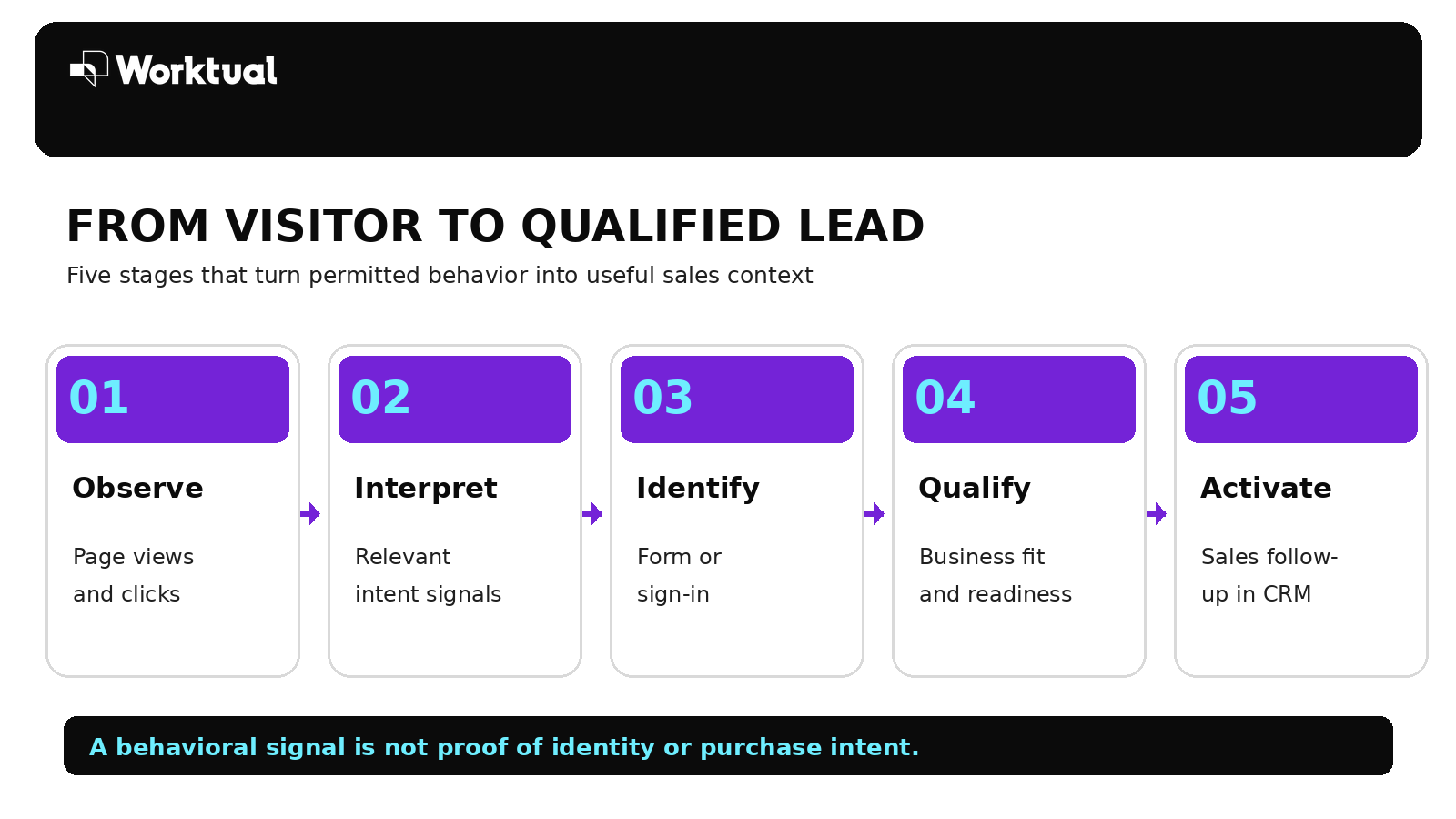
From Anonymous Visitor to Qualified Lead: The Five-Stage Journey

Consider a technology leader evaluating an enterprise CRM platform.

Stage 1: Capture Website Activity

The buyer visits product and integration pages. Permitted interactions are recorded against a pseudonymous identifier.

The business understands the activity, not necessarily the individual.

Stage 2: Recognize Intent Signals

The buyer returns to examine pricing, implementation requirements, and customer examples.

Repeated engagement may indicate interest. However, a single page visit should not establish purchasing intent.

Stage 3: Connect a Known Identity

The buyer submits a demo request with business contact information.

Where reliable identifiers and privacy requirements allow, earlier interactions may become part of the known customer journey.

Stage 4: Evaluate Lead Quality

Behavioral lead scoring becomes more useful when combined with business context.

Qualification should consider:

  • Engagement: Relevant content and repeat visits.
  • Business fit: Industry, organization size, and requirements.
  • Readiness: Confirmed needs and purchasing timeline.

A highly engaged visitor isn’t necessarily a sales-qualified lead.

Stage 5: Enable Sales Engagement

An appropriately integrated CRM makes relevant customer context available to sales teams.

Representatives can prioritize qualified opportunities and tailor conversations to demonstrated interests and stated requirements.

Anonymous Visitor to Qualified Lead CDP and WebTracking

What Should Businesses Measure?

Website traffic alone doesn’t reveal pipeline quality. The real measure is how effectively visitor engagement translates into qualified sales opportunities.

MetricWhat it measures
Anonymous-to-known conversion rateEligible anonymous identities becoming known
Visitor-to-lead conversion rateEligible visitors becoming leads
Marketing Qualified Lead (MQL) rateLeads meeting marketing qualification criteria
Sales Qualified Lead (SQL) rateLeads meeting sales qualification criteria
Lead-to-opportunity conversion rateQualified leads progressing into opportunities

For consistent reporting, divide each outcome by its relevant eligible population, then multiply by 100.

For example, if 200 leads are generated and 40 meet marketing’s qualification criteria, the MQL rate is 20%.

But that percentage matters only when qualified leads progress toward meaningful sales opportunities.

The goal is better pipeline quality, not simply more leads.

Privacy and Data Quality Cannot Be Afterthoughts

Connecting customer interactions requires responsible data practices.

Organizations should address:

  • Applicable US privacy and consent requirements.
  • Duplicate records and inaccurate identifiers.
  • Cross-device limitations and incomplete information.
  • Data retention, access controls, and authorized usage.

Identity resolution cannot connect every interaction. Forcing uncertain matches risks creating misleading customer profiles.

Accurate, appropriately governed information is more valuable than an artificially complete customer record.

Where Worktual Fits

Worktual brings together Web Tracking, Cognitive CDP, and AI-Native CRM within its broader AI-native enterprise ecosystem.

Each solution addresses a distinct business need:

  • Web Tracking: Provides visibility into website engagement and customer journeys.
  • Cognitive CDP: Brings customer information together to support a more unified view.
  • AI-Native CRM: Supports lead management and sales workflows.

The broader opportunity is connecting customer intelligence with business processes while maintaining appropriate governance and control.

Organizations can explore these capabilities individually or as part of a more connected approach.

Conclusion

A demo request is often the first moment a prospect becomes visible to sales, but rarely their first interaction with a business.

Web tracking captures engagement signals. A CDP can organize relevant customer information. CRM workflows help translate qualified context into informed sales action.

The objective isn’t to track everything. It’s to understand what matters and act on reliable information.

Make customer context count.

Talk to Worktual about your business requirements

Frequently Asked Questions

1. How does a CDP identify anonymous website visitors?

A CDP may associate anonymous activity with known customer profiles using reliable identifiers and configured matching rules.

2. Can website behavior determine buying intent?

Website behavior can suggest interest. Qualification also requires business fit, relevant requirements, and purchasing readiness.

3. What is the difference between web analytics and a CDP?

Web analytics measures website activity and performance. A CDP brings customer information from multiple sources together.

4. Can every anonymous visitor be identified?

No. Missing identifiers, device changes, privacy restrictions, and incomplete data can prevent reliable identification.

Related Posts

AI Native Customer Experience Architecture

AI-Native Customer Experience Architecture: From Data to Autonomous Action

Insurance organizations operate in a complex, regulation-driven, margin-sensitive environment where growth depends on efficient onboarding, strong retention, and effective cross-sell across product lines. AI in insurance is central to this shift, as customers expect seamless digital onboarding journeys, real-time responses, and personalized communication across channels. Whether purchasing a policy, renewing coverage, or managing claims, expectations are shaped by digital-first experiences.

AI Native vs AI Powered SaaS

AI-Native vs AI-Powered SaaS: What Is the Difference?

Insurance organizations operate in a complex, regulation-driven, margin-sensitive environment where growth depends on efficient onboarding, strong retention, and effective cross-sell across product lines. AI in insurance is central to this shift, as customers expect seamless digital onboarding journeys, real-time responses, and personalized communication across channels. Whether purchasing a policy, renewing coverage, or managing claims, expectations are shaped by digital-first experiences.

AI Insurance pre Authorization Verification Enterprise Healthcare

AI Prior Authorization Verification: Enterprise Healthcare

Insurance organizations operate in a complex, regulation-driven, margin-sensitive environment where growth depends on efficient onboarding, strong retention, and effective cross-sell across product lines. AI in insurance is central to this shift, as customers expect seamless digital onboarding journeys, real-time responses, and personalized communication across channels. Whether purchasing a policy, renewing coverage, or managing claims, expectations are shaped by digital-first experiences.