Solutions
Resources
Let's talk

The Enterprise AI Governance Challenge: How to Scale Autonomous Customer Decisions Without Losing Control 
Insights / The Enterprise AI Governance Challenge: How to Scale Autonomous Customer Decisions Without Losing Control 
Enterprise AI Governance Autonomous Decisions

The Growing Need for Enterprise AI Governance

AI agents are moving beyond answering questions. They can classify requests, update records, and initiate customer workflows. That creates a more demanding question for leaders: who controls the decisions these systems are allowed to make?

The UK government’s 2026 AI adoption research found that 32% of businesses used at least one AI technology, up from 16% in 2025. Adoption among larger firms reached 52%. These figures measure AI adoption broadly, not autonomous agents specifically.

Enterprise AI governance establishes the permissions, oversight and evidence needed to scale autonomy without surrendering accountability.

Why Are Businesses Struggling to Govern Autonomous AI Agents?

Traditional automation follows defined steps. Autonomous AI agents can select actions from available tools, making boundaries harder to supervise, especially across multi-agent AI systems.

  • Agents accessing more customer data than their tasks require.
  • Decisions made without a clear explanation or accountable owner.
  • Multiple systems executing actions without a shared audit record.
  • Insufficient monitoring of policy breaches, errors, and unusual behaviour.

How Autonomous AI Agents Are Transforming Customer Operations

Autonomous AI agents can support customer operations when each action has approved permissions and a defined escalation path.

Business operationIllustrative AI agent application
Customer supportAnswer routine queries and propose resolutions
Lead managementAssess and route incoming leads
CRM operationsUpdate authorised customer fields
Ticket managementClassify cases and route them to the right team
Accounts receivablePrepare payment reminders and handle invoice queries

In coordinated workflows, one agent may classify a request while another prepares the next action. The system should verify each agent’s authority before anything changes in a customer account.

Six Essential Layers of Enterprise AI Governance

A practical AI governance framework should combine these six safeguards:

  • Decision boundaries. Specify actions agents may complete, recommend or never execute.
  • Access control. Use role-based, least-privilege access to data and tools.
  • Human oversight. Require approval for sensitive or high-impact decisions.
  • Real-time monitoring. Detect abnormal behaviour, failed actions, and policy exceptions.
  • Audit trails. Record inputs, actions, approvals, tool calls and outcomes.
  • Risk assessment. Test security, fairness, reliability, and failure scenarios regularly.

These controls need to exist in enforceable workflows, not only in agent instructions. The UK National Cyber Security Centre recommends monitoring system behaviour and logging appropriate inputs, subject to privacy and data protection requirements.

UK AI Governance: What Businesses Need to Consider

The UK uses a context-specific, regulator-led approach to AI. Organisations should assess the particular use case, personal data involved and sector requirements rather than assume one universal AI compliance checklist applies.

UK GDPR continues to require lawful, fair and transparent processing, appropriate security and respect for individual rights. The Data (Use and Access) Act 2025 amended the rules for solely automated significant decisions. Where its safeguards apply, people must be informed and able to make representations, obtain human intervention, and contest the decision. Additional restrictions remain for decisions involving special category data.

A significant decision has a legal or similarly significant effect on someone; it is solely automated when there is no meaningful human involvement. The ICO advises organisations to assess the actual decision and applicable safeguards. Financial services, healthcare, and other regulated sectors may have further obligations.

How Can Businesses Scale AI Automation Without Losing Customer Trust?

Start with low-risk work, then expand agent permissions only after reviewing outcomes. A practical rollout should:

  • Define an action owner, permission scope and escalation threshold.
  • Test exceptions, capture decision records, and monitor customer impact.
  • Review incidents and audit findings before increasing autonomy.

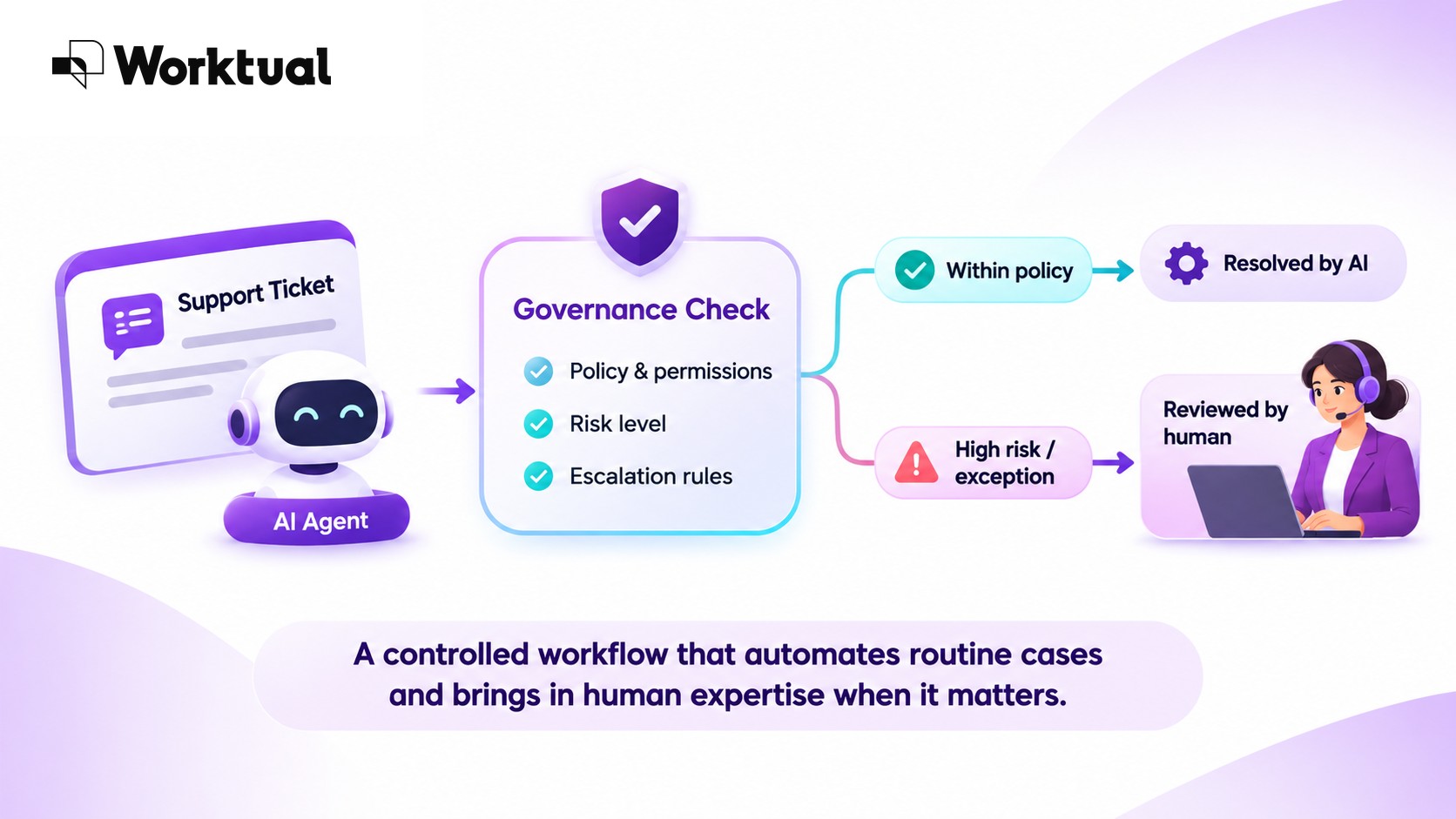
Consider a support agent handling a refund request. It can check the policy and collect case details, but a disputed or high-value exception should reach an authorised employee. That handover should include the relevant evidence, rather than simply asking someone to “review”.

Enterprise AI Governance

Measuring Enterprise AI Governance Effectiveness

Measure not only efficiency but whether decisions remain controlled and explainable.

KPIMeasurement
Decision accuracyPolicy-aligned correct decisions ÷ reviewed decisions
Escalation rateCases referred to humans ÷ eligible cases
Policy violationsUnauthorised or non-compliant actions per period
Audit coverageTraceable decisions ÷ total decisions
Customer satisfactionCSAT or post-resolution customer feedback

Where Worktual Fits

Worktual offers AI-native solutions that bring customer information, interactions and service workflows into a more connected business environment. Its connected ecosystem helps organisations manage customer interactions, information and service workflows while keeping human oversight central to critical decisions.

Relevant Worktual solutions include:

  • AI-Native CRM: Manage customer records, leads and sales activities with better visibility across business workflows.
  • AI Contact Centre: Manage customer conversations across channels and support efficient service delivery.
  • Ticketing System: Organise, categorise and manage customer support requests with clear ownership and follow-up.
  • Cognitive CDP: Bring customer information together to provide a more connected view of customer interactions and needs.

Together, these solutions provide a foundation for more connected customer operations, where businesses can introduce AI capabilities while maintaining appropriate governance, accountability, and operational control.

Conclusion: Building Controlled Autonomy with Enterprise AI

The aim of AI governance is not to stop autonomous systems from working. It is to make their decisions accountable, observable, and appropriate to the risk involved.

Start with bounded actions, establish clear oversight, and expand autonomy only when the evidence supports it. Responsible AI adoption depends on balancing operational efficiency with security, accountability, and customer trust.

Explore how Worktual’s AI-native solutions can support more controlled and connected business operations.

FAQs

1. What is enterprise AI governance?

The policies, technical controls, and accountability structures used to manage AI decisions and actions across an organisation.

2. What is agentic AI governance?

Governance specifically addressing agents that select tools, coordinate workflows, and perform actions within permitted boundaries.

3. How can businesses control autonomous AI agents?

Set permissions, require human approval for sensitive actions, monitor activity, and preserve audit records.

4. Why is human oversight important in AI decision-making?

It provides an accountable review path when decisions are sensitive, uncertain, disputed, or potentially consequential.

5. How does UK GDPR affect enterprise AI governance?

Organisations processing personal data must assess lawful use, transparency, security and individual rights. Solely automated significant decisions require relevant safeguards under the amended UK GDPR; restrictions for certain special category data also remain.

Related Posts

Auditable AI UK Financial Services Compliance

Auditable AI: What UK Financial Services Compliance Teams Actually Need to Prove

An AI CRM is customer relationship management software with artificial intelligence built into its core workflows. Rather than simply storing contact records, it scores leads, drafts follow-ups, forecasts deals, and surfaces the next action automatically. The difference from a normal CRM is not an added chatbot; it is that the software itself does some of the work, not just the record-keeping.

UK Retail AI Adoption Results Gap

Beyond the Pilot: What UK Retailers Need to Turn AI Adoption Into Measurable Results

Business-to-business (B2B) customer engagement has changed significantly as buyers now expect faster responses, connected interactions, and highly personalised experiences across every stage of the customer journey. Decision-makers no longer compare B2B experiences only with competitors within the same industry. They compare them with the seamless digital experiences they receive across retail, banking, streaming platforms, and consumer applications. This shift has increased pressure on enterprises to modernise how they manage customer relationships, support operations, and lifecycle engagement.

Natwest AI Transformation UK Customer Experience

Redesign From the Outcome Backward: What NatWest’s AI Transformation Shows About UK Customer Experience

Business-to-business (B2B) customer engagement has changed significantly as buyers now expect faster responses, connected interactions, and highly personalised experiences across every stage of the customer journey. Decision-makers no longer compare B2B experiences only with competitors within the same industry. They compare them with the seamless digital experiences they receive across retail, banking, streaming platforms, and consumer applications. This shift has increased pressure on enterprises to modernise how they manage customer relationships, support operations, and lifecycle engagement.