Solutions
Resources
Let's talk

One Customer Request, Multiple Business Processes: Can Multi-Agent AI Handle the Entire Journey?

Insights / One Customer Request, Multiple Business Processes: Can Multi-Agent AI Handle the Entire Journey?
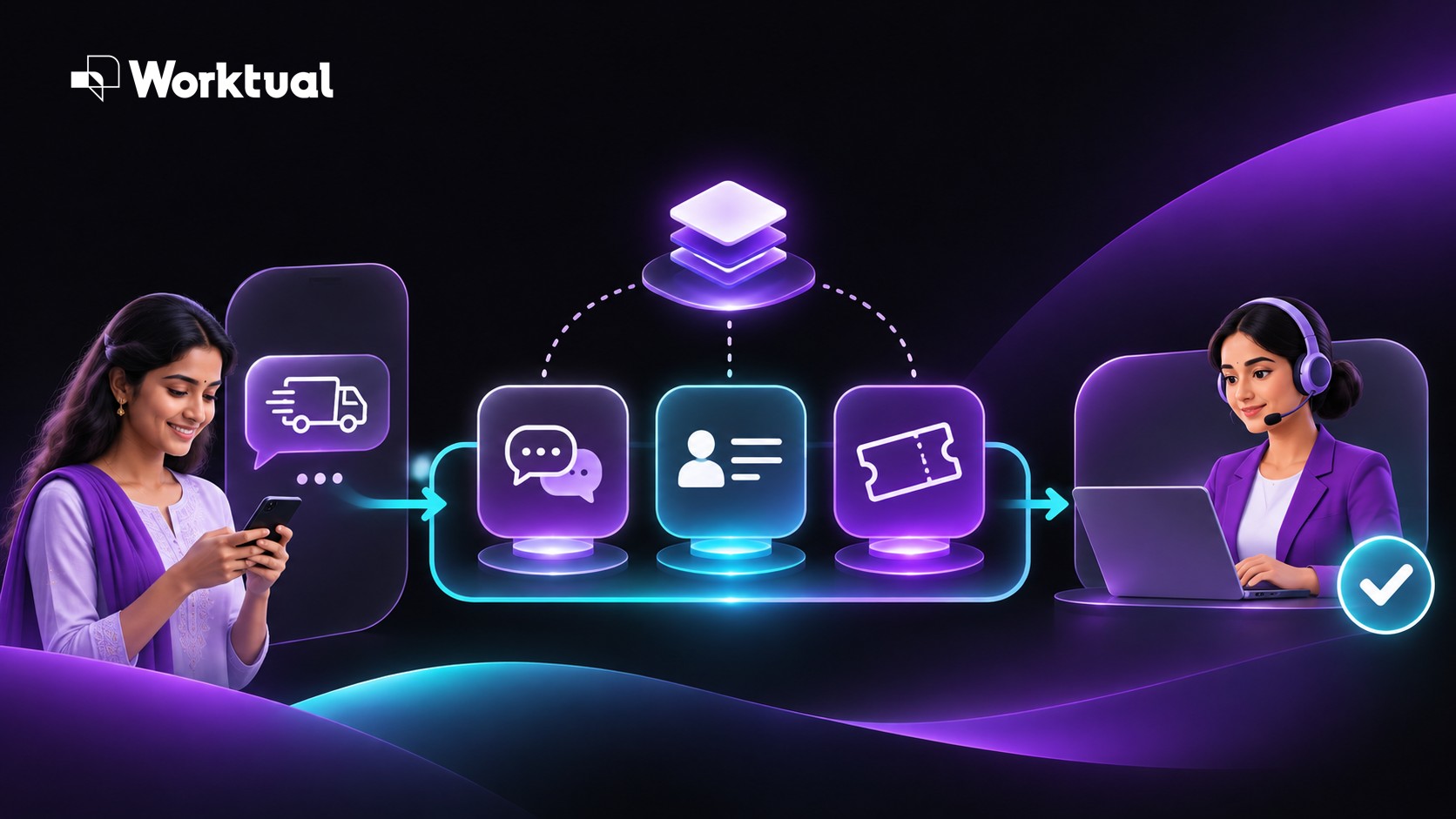
Multi Agent AI Customer Service Workflows India

Why One Customer Request Shouldn't Require Multiple Manual Handovers

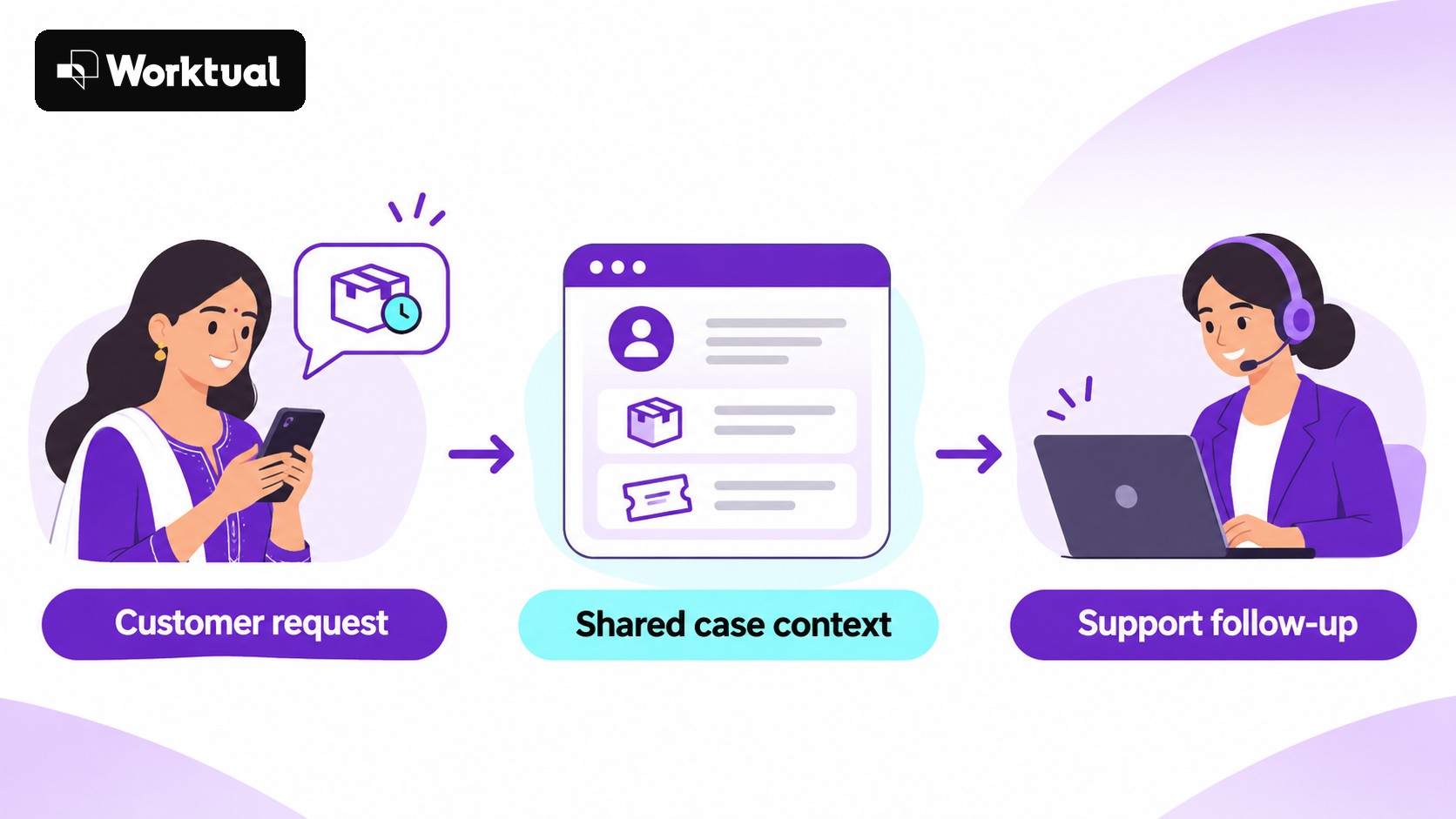
An online shopper in Pune reports a delayed delivery through website chat. The next morning, she follows up on WhatsApp, then calls support. Each time, she explains the same problem.

The difficulty is not the number of channels. Customer records, delivery policies and support tickets may sit in separate systems, leaving teams to reconstruct the case.

Multi-agent AI for customer service offers a way to coordinate specialised tasks around one request. The important question is whether those tasks can share a reliable context and reach an authorised outcome.

What Is Multi-Agent AI in Customer Service?

Multi-agent AI uses specialised AI agents to perform different tasks within a coordinated workflow. One may interpret a request, another retrieve customer records, while a third consults approved knowledge. An orchestration layer manages sequencing, permissions, and handovers.

Traditional chatbotSingle AI agentMulti-agent AI system
Answers common questionsPerforms a defined taskCoordinates specialised tasks
Limited workflow executionUses approved toolsLinks connected workflows
Often needs manual handoversHandles specific actionsSupports a broader process

Coordination requires reliable system connections. Multiple agents alone do not create an end-to-end service.

How Can Multiple AI Agents Handle One Customer Request?

Consider the delayed e-commerce delivery:

  1. Customer interaction: Conversational AI understands the query and captures the order reference.
  2. CRM context: An authorised CRM capability retrieves the customer’s available details and previous contacts.
  3. Knowledge retrieval: A knowledge agent finds the applicable delivery and escalation policy.
  4. Ticketing: A ticket is created or updated with the issue, history, and responsible team.
  5. Orchestration: The workflow determines the next permitted step, such as requesting a logistics update.
  6. Human review: A disputed delivery or compensation request moves to an authorised employee.
  7. Customer update: The response and case history are recorded for future contact.

Retrieving a policy is not the same as confirming shipment status. Tracking an order, changing delivery instructions, or issuing a refund requires verified system access and approval rules.

How Do CRM, Ticketing and Knowledge Intelligence Work Together?

ComponentResponsibilityCustomer value
CRMProvides permitted customer contextLess repetition
TicketingMaintains case status and ownershipClearer follow-up
Knowledge intelligenceRetrieves approved service policiesMore consistent answers
OrchestrationCoordinates task sequenceFewer disconnected handovers

A useful handover transfers the order reference, earlier conversation and actions already attempted. It should not force customers to start again.

Multi Agent AI Customer Service Workflows

Why Indian Businesses Need Connected Customer Operations

A shared case history can preserve context even when the customer changes channels.

Customers may move between websites, WhatsApp, chat, and telephone support. They also expect assistance in languages that are familiar to them.

The IAMAI–Kantar *Internet in India 2024* report found that 57% of urban internet users preferred accessing content in Indic languages. This is an internet-content preference measure, not a customer-service satisfaction rate.

The operational need appears across industries:

For any sector, retaining one case history across channels is more useful than adding another isolated chatbot.

Multi-Agent AI vs Traditional Customer Service Automation

Traditional automation suits predictable tasks, such as sending a standard acknowledgement. Multi-agent systems become relevant when requests require different information sources, decisions, and departments.

They can offer flexible routing and shared context, but introduce coordination costs, uncertain model outputs, and additional failure points. Simpler automation remains preferable where rules are stable, and the workflow is narrow.

What Challenges Should Businesses Consider?

Before deployment, assess six practical risks:

  • Fragmented data: Establish trusted sources and consistent identifiers.
  • System integration: Verify what CRM and ticketing tools can actually do.
  • Task ownership: Assign responsibility for each action and exception.
  • Privacy: Limit access to necessary customer information.
  • Response quality: Validate answers against approved evidence.
  • Human escalation: Keep consequential decisions reviewable.

India’s Digital Personal Data Protection Act, 2023 and the DPDP Rules, 2025 have phased commencement dates. Businesses should check which provisions apply at deployment and design access, retention and audit controls accordingly.

Where Worktual Fits

Worktual offers AI-native solutions that support connected customer operations, helping businesses manage conversations, customer information and service requests across relevant workflows.

Its current solutions include:

  • AI-Native CRM: Manage customer records, interactions and sales activities.
  • AI Contact Centre: Support customer conversations across communication channels.
  • Ticketing System: Organise service requests, track progress and maintain issue ownership.

For example, an e-commerce business could use these capabilities to manage a delayed delivery enquiry across customer engagement and support processes.

As multi-agent capabilities evolve, the opportunity is to coordinate these activities more effectively, with appropriate permissions, shared context and human oversight.

What Does the Future Mean for Indian Businesses?

The direction is towards more specialised assistance, better coordination between systems, and stronger human oversight.

EY India’s November 2026 customer-service research found that only 23% of surveyed organisations reported high or very high AI value realisation. This measures AI in customer service broadly, not multi-agent systems specifically.

Success will depend on measurable service outcomes, rather than the number of agents deployed.

Conclusion: From Disconnected Processes to Connected Service

One customer request can involve several departments. Multi-agent AI can help coordinate work, but trustworthy integration, clear permissions, and human accountability determine whether it improves the experience.

Explore how Worktual’s customer service solutions can support more connected business operations.

Frequently Asked Questions

1. What is multi-agent AI in customer service?

A coordinated system of specialised AI agents that contribute to a shared service workflow. 

2. How do multiple agents resolve one request?

They retrieve relevant information, coordinate permitted tasks, and escalate exceptions to people. 

3. How is it different from chatbots?

A chatbot mainly handles conversation; multi-agent systems coordinate distinct operational tasks. 

4. Can it connect CRM, ticketing and knowledge systems? Potentially, where necessary interfaces, permissions, and data quality exist. 

5. How can it help Indian businesses?

By maintaining context across channels, languages, and departments. 

6. Does it replace human support?

No. Sensitive, uncertain, and approval-dependent matters still need accountable people. 

7. What are the main implementation challenges?

Integration, data quality, orchestration, privacy, accuracy, and oversight. 

8. How should effectiveness be measured?

Track first-contact resolution, repeat contacts, handover quality, resolution time and customer satisfaction.

Related Posts

Conversational AI Loan Disbursement Status India

Conversational AI for Real-Time Loan and Disbursement Status in India

The Indian B2B landscape is shifting fast. Customer expectations are rising, sales cycles are getting longer, and the volume of customer data most businesses generate has outpaced what traditional spreadsheets or legacy CRM systems can handle. AI CRM software was built precisely for this inflection point.

Autonomous Enterprise Velocity India CEO

Autonomous Enterprise Velocity: Scaling Across India Without Multiplying Complexity

The Indian B2B landscape is shifting fast. Customer expectations are rising, sales cycles are getting longer, and the volume of customer data most businesses generate has outpaced what traditional spreadsheets or legacy CRM systems can handle. AI CRM software was built precisely for this inflection point.

AI Native Indian Healthcare

Why AI-Native Matters More in India’s Healthcare System Than Anywhere Else

Financial institutions operate in a highly competitive, regulation-driven, and margin-sensitive environment where revenue growth is no longer driven by acquisition alone. Banks, fintechs, and Non-Banking Financial Companies (NBFCs) continue to invest heavily in digital acquisition, yet face persistent challenges such as low onboarding completion, rising contact centre costs, increasing churn, and fragmented customer data. At the same time, customers expect instant responses, seamless onboarding, personalised financial guidance, and consistent service across digital and assisted channels. When these expectations are not met, conversion drops, churn increases, and cost-to-serve rises, often before the impact is fully visible in performance metrics.