

AI-Native Cognitive Data Platform for Retail: Solving Fragmented Customer Journeys, Cart Abandonment, and Inconsistent Personalisation
Insights / AI-Native Cognitive Data Platform for Retail: Solving Fragmented Customer Journeys, Cart Abandonment, and Inconsistent Personalisation

Table of Contents
Today’s retail customer doesn’t follow a linear buying journey. They discover products on social media, compare prices across marketplaces, browse mobile apps, visit physical stores, read reviews, engage with customer support, abandon carts, and often return days later through an entirely different channel. Harvard Business Review reports that nearly 73% of shoppers engage across multiple channels before making a purchase, while the Baymard Institute estimates that almost 70% of online shopping carts are abandoned. For retailers, this translates into fragmented customer journeys, missed revenue opportunities, and increasingly difficult personalisation challenges.
Addressing these challenges requires more than simply consolidating customer data into a single repository. Retailers need an intelligent data platform that continuously connects behavioural signals, purchase history, service interactions, and engagement activity to create a unified, real-time view of every customer.
• The Retail Intelligence Journey
• What Cognitive Customer Data Platforms mean for retail customer intelligence and growth
• Traditional CDP Vs Cognitive CDP
• Retail challenges affecting customer journeys, cart abandonment, and personalization
• Retail Challenge – Business Impact
• Solutions retailers need to improve omnichannel engagement and customer lifecycle performance
• Why Worktual delivers measurable ROI for retailers in India
• FAQs
The Retail Intelligence Journey
The diagram below shows how a Cognitive Customer Data Platform transforms fragmented customer interactions into unified customer intelligence that supports better commercial outcomes.
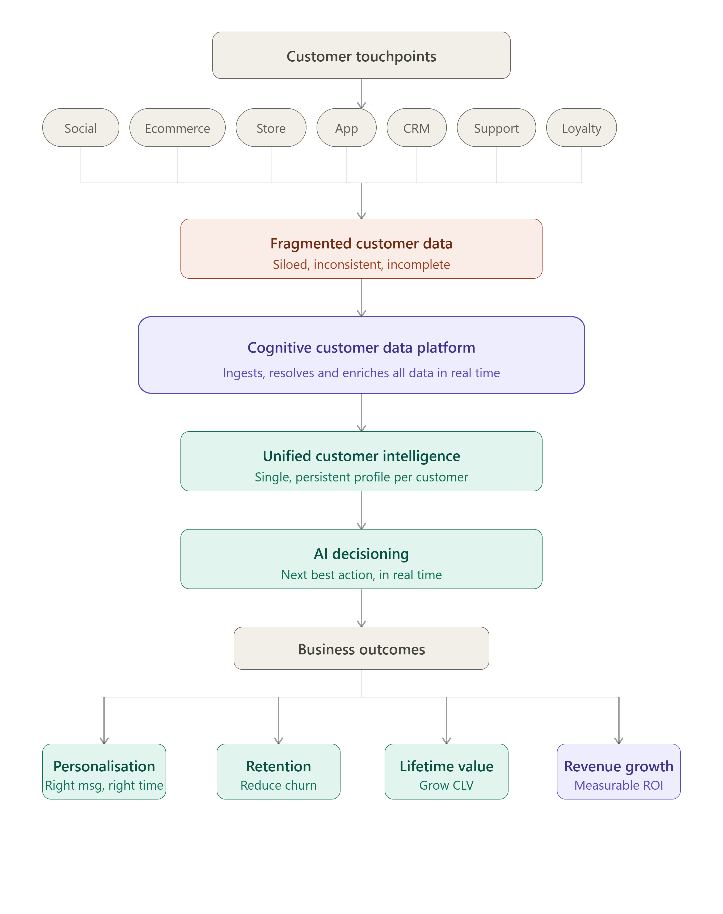
By interpreting customer intent, identifying patterns, and recommending the next best action, such a platform enables businesses to move beyond descriptive reporting to predictive, context-aware decision-making. The result is more relevant customer engagement, reduced cart abandonment, stronger retention, and a scalable foundation for omnichannel retail growth.
For retailers in India, the challenge extends beyond digital transformation to managing customer intelligence across one of the world’s fastest-growing and most dynamic retail ecosystems. The rapid expansion of ecommerce, quick commerce, omnichannel retail, digital payments, and social commerce has created new opportunities to engage customers, while also increasing the complexity of managing customer journeys. As competition intensifies and customer expectations continue to evolve, the ability to recognise, understand, and engage customers consistently across every touchpoint is becoming a key competitive advantage for retailers seeking sustainable growth.
What Cognitive Customer Data Platforms mean for retail customer intelligence and growth
Beyond centralising customer information, a Cognitive Customer Data Platform (CDP) functions as a continuously learning intelligence layer that interprets behavioural intent, contextual engagement patterns, and evolving customer journeys in real time. Rather than relying solely on static reporting or historical segmentation, it enables retailers to move towards inference-driven decision-making, where AI evaluates behavioural signals, predicts likely outcomes, and recommends next-best actions across the customer lifecycle.
By unifying customer data, transactional history, behavioural signals, engagement activity, and lifecycle interactions into a single intelligence layer, a Cognitive CDP eliminates fragmented customer records across ecommerce platforms, CRM systems, loyalty programmes, customer service applications, and marketing tools.
Traditional CDP Vs Cognitive CDP
While both platforms consolidate customer data, a Cognitive CDP goes further by interpreting customer behaviour and recommending actions in real time.
| Traditional CDP | Cognitive CDP |
|---|---|
| Collects customer data | Interprets customer behaviour |
| Static profiles | Dynamic customer intelligence |
| Historical reporting | Predictive decision-making |
| Audience segmentation | Next-best-action recommendations |
| Stores data | Drives business outcomes |
| Supports reporting | Enables decision-making |
Key Business Benefits of Cognitive CDP
- Unified customer intelligence across every touchpoint
- Real-time behavioural insights
- More precise audience segmentation
- Higher Customer Lifetime Value (CLV)
- Faster, AI-assisted decision-making
- Improved marketing effectiveness
- Stronger customer retention
As retail journeys become increasingly omnichannel, organisations need intelligence that adapts in real time as customers move between digital and physical touchpoints. A Cognitive CDP provides that foundation by continuously learning from customer behaviour, orchestrating context-aware engagement, and helping businesses improve conversion rates, optimise marketing spend, increase repeat purchases, and drive sustainable revenue growth.
Retail challenges affecting customer journeys, cart abandonment, and personalisation
Retailers are expected to deliver seamless, personalised experiences across every customer interaction, yet fragmented customer journeys, inconsistent personalisation, and high cart abandonment continue to undermine those efforts.
Customer intelligence is often fragmented across:
- Ecommerce platforms
- CRM systems
- Loyalty programmes
- Marketing platforms
- Customer service applications
- Physical retail systems
Without a unified view of customer behaviour, organisations struggle to:
- Recognise customer intent
- Personalise engagement
- Recover abandoned carts
- Optimise marketing spend
- Increase repeat purchases
- Maximise CLV
The result is lower conversion, higher acquisition costs, weaker retention, and reduced profitability.
Retail Challenge – Business Impact
Fragmented customer intelligence creates a chain reaction that affects every stage of the retail lifecycle, from customer engagement through to profitability.
Fragmented Data
↓
Poor Customer Visibility
↓
Generic Personalisation
↓
Cart Abandonment
↓
Lost Revenue
↓
Lower CLV
Solutions retailers need to improve omnichannel engagement and customer lifecycle performance
Modern retailers need connected intelligence, not simply connected systems.
Customer data should evolve from static records into continuously updated intelligence that preserves context across every touchpoint. This enables organisations to understand not only what customers have done, but why they are behaving that way and what action should happen next.
Leading retailers are increasingly investing in platforms that provide:
- Unified customer profiles
- Behavioural intelligence
- Predictive decision-making
- Lifecycle orchestration
- AI-driven personalisation
- Real-time omnichannel engagement
This evolution is particularly important in India, where organised retail continues to expand alongside ecommerce, quick commerce, and digital-first shopping experiences. As retailers compete to acquire and retain increasingly connected consumers, the ability to interpret customer behaviour in real time, personalise engagement at scale, and orchestrate consistent experiences across digital and physical channels has become essential for improving conversion, strengthening loyalty, and driving sustainable growth.

Why Worktual delivers measurable ROI for retailers in India
In India’s rapidly evolving retail landscape, customer intelligence has become a strategic business asset. As retailers expand across ecommerce, quick commerce, marketplaces, mobile applications, loyalty programmes, and physical stores, they need the ability to interpret customer behaviour in real time, personalise engagement at scale, improve conversion, strengthen customer loyalty, and maximise CLV.
Worktual combines an AI-native Cognitive Customer Data Platform with a consultancy-led approach to customer intelligence, Customer Value Management, and lifecycle optimisation. Rather than simply consolidating customer records, Worktual creates a continuously evolving intelligence layer that helps retailers identify customer intent earlier, personalise engagement with greater precision, and make faster business decisions.
How Worktual creates measurable business value
• Improves conversion and repeat purchases
• Reduces cart abandonment
• Strengthens customer retention
• Increases CLV
• Optimises promotional spend
• Improves marketing efficiency
• Supports profitable long-term growth
Unlike conventional CDPs that primarily support reporting and segmentation, Worktual operationalises customer intelligence across marketing, ecommerce, customer service, and loyalty operations. The result is a platform that aligns customer engagement with measurable commercial objectives, enabling retailers to improve profitability, reduce cost-to-serve, and build a more resilient retail business.
Worktual’s consultancy-led approach ensures that technology is aligned with each retailer’s commercial priorities, whether that is increasing revenue, reducing cost-to-serve, improving loyalty performance, or optimising omnichannel engagement. The result is a platform that supports profitable, long-term retail growth rather than isolated customer engagement initiatives.
FAQs
1. What is a Cognitive Customer Data Platform (CDP)?
A Cognitive Customer Data Platform (CDP) connects customer data, behavioural signals, transactional activity, and engagement interactions into a unified intelligence layer. Unlike traditional customer data platforms that primarily centralise information, a Cognitive CDP continuously learns from customer behaviour using AI to improve personalisation, engagement, and customer lifecycle management across digital and physical retail channels.
2. How is a Cognitive CDP different from a traditional CDP?
Traditional CDPs focus on consolidating customer data for reporting, segmentation, and campaign activation. A Cognitive CDP builds on this foundation by adding AI-driven intelligence, predictive analytics, real-time behavioural insights, and next-best-action recommendations. Rather than simply storing customer information, it enables retailers to make faster, more informed decisions throughout the customer lifecycle.
3. Why do retailers need a Cognitive Customer Data Platform?
Retailers increasingly operate across ecommerce, mobile apps, physical stores, marketplaces, loyalty programmes, and customer service channels. A Cognitive CDP helps unify these interactions into a connected customer view, enabling better visibility into customer behaviour, more relevant personalisation, improved customer retention, and reduced revenue leakage from fragmented customer journeys.
4. How does a Cognitive Customer Data Platform create unified customer profiles?
A Cognitive CDP creates unified customer profiles by connecting behavioural data, transactional history, loyalty activity, browsing behaviour, customer service interactions, and engagement data from multiple systems into a continuously updated customer view. This enables retailers to understand customer intent more accurately and deliver more relevant experiences across every touchpoint.
5. Can a Cognitive Customer Data Platform help reduce cart abandonment?
Yes. Cognitive CDPs identify behavioural signals, purchase intent, and engagement friction throughout the buying journey. By enabling retailers to trigger personalised reminders, contextual recommendations, and timely customer engagement, they help improve conversion rates and recover revenue that might otherwise be lost through abandoned carts.
6. How does AI improve retail customer personalisation?
AI analyses customer behaviour, purchase patterns, product affinity, browsing history, and engagement activity in real time to identify trends and predict customer intent. This enables retailers to deliver more relevant recommendations, personalised offers, and context-aware experiences across digital and physical retail channels.
7. Why is omnichannel orchestration important in retail?
Today’s customers expect a consistent experience regardless of whether they interact through ecommerce websites, mobile apps, physical stores, marketplaces, or customer service channels. Omnichannel orchestration ensures customer context is preserved across these interactions, enabling retailers to deliver seamless engagement, improve customer satisfaction, and strengthen long-term loyalty.
8. How is Worktual different from standard retail customer data platforms?
Worktual combines an AI-native Cognitive Customer Data Platform with a consultancy-led approach to customer intelligence, Customer Value Management, and lifecycle optimisation. Rather than functioning as a static customer database, Worktual continuously interprets behavioural signals, predicts customer intent, and enables retailers to operationalise customer intelligence across marketing, ecommerce, customer service, and loyalty operations. The result is a connected intelligence platform designed to improve conversion, strengthen customer retention, maximise CLV, and deliver measurable commercial outcomes.

Related Posts

Autonomous Brand Responsiveness: What It Actually Means for Indian Marketing Leaders
The Indian B2B landscape is shifting fast. Customer expectations are rising, sales cycles are getting longer, and the volume of customer data most businesses generate has outpaced what traditional spreadsheets or legacy CRM systems can handle. AI CRM software was built precisely for this inflection point.

Does Your Business Need to Register as a DPDP Consent Manager?
Financial institutions operate in a highly competitive, regulation-driven, and margin-sensitive environment where revenue growth is no longer driven by acquisition alone. Banks, fintechs, and Non-Banking Financial Companies (NBFCs) continue to invest heavily in digital acquisition, yet face persistent challenges such as low onboarding completion, rising contact centre costs, increasing churn, and fragmented customer data. At the same time, customers expect instant responses, seamless onboarding, personalised financial guidance, and consistent service across digital and assisted channels. When these expectations are not met, conversion drops, churn increases, and cost-to-serve rises, often before the impact is fully visible in performance metrics.

Can AI Help Hospital Networks Meet IRDAI’s 1-Hour Cashless Authorisation Deadline?
The Indian B2B landscape is shifting fast. Customer expectations are rising, sales cycles are getting longer, and the volume of customer data most businesses generate has outpaced what traditional spreadsheets or legacy CRM systems can handle. AI CRM software was built precisely for this inflection point.


